The Weekend Dish-Herb Vinegar

Writers and cooks know one true thing and that is, as Stanley Kunitz said,

Just as a tapestry cannot be woven out of a single set of threads…you need another set of threads as counterweave…

So go ahead and make your Christmas cookies and fudges, cakes, pies and candies. But when you need something to cut the sweet, consider creating a batch of herb-infused vinegars.

040

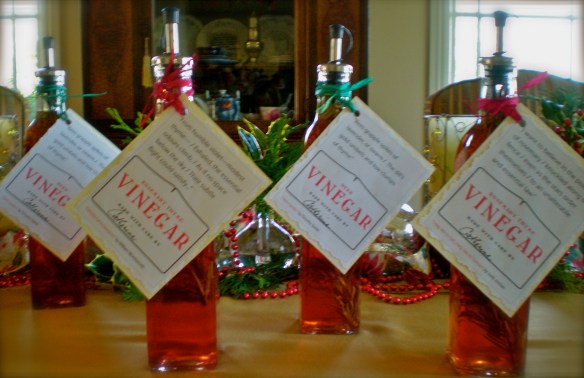
There are endless possible combinations, but I created this one to put forth a ruby jewel color and to make use of the bounty of my herb garden. You can buy clear bottles, or put the empty Pinot Grigio bottles out of their recycle bin misery and let them be the life of the party again.

For PDF labels, complete with poetry quotes courtesy of the Academy of American Poets, click here.

    Backyard Sisters Herb Vinegar
– 1 sprig rosemary
– Several twigs of thyme
Wash herbs and air dry. Slip them carefully into the bottle.

In a separate container, preferably several large pitchers or bowls, mix equal parts:
– Apple Juice
– Apple Cider Vinegar
– Red Wine Vinegar
– White Vinegar
– Rice Vinegar
– Cooking Sherry
Stir. Fill bottles.  Using a funnel helps immensely, but I’m pretty sure you already know that.

It’s so easy to make, even a writer can do it.

~ Catherine

Here a word, there a word…

“Did I forget to look at the sky this morning / 
when I first woke up?”

Dawn

So begins Jim Moore’s,”Twenty Questions,” one of my favorite poems to read as a reminder to live attentively. When I take Moore’s attitude of inquiry into the day, I’m frequently rewarded with a high word count of odd snippets which I hoard like gold to incite new projects. And then I lose my words within the dozens and dozens of journals I’ve kept for years.

I once attended a reading where Charles Simic and Laure-Anne Bosselaar stood in front of a large audience and spun magic from their tattered leather journals, taking rapt listeners from first jot to finished poem like sure-footed adults leading children over stepping stones in a rushing river.

My process is infinitely messier.
DSCN2341

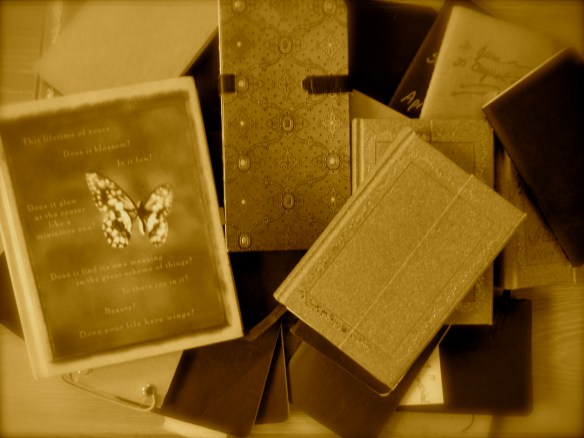
I keep journals everywhere.  Stacks of filled Moleskins pile up in a purple silk-wrapped box on my bookshelf. There are three journals on my bedside table, one in my purse, another in my messenger bag, and a water-spotted, sandy one in my beach backpack. There’s a slim brown journal in my car, a hardback one in my upstairs office, and the smallest journal of all waits downstairs by my muddy shoes.  I slip it into my jeans pocket before every hike.

Writing is the easy part.  Keeping track of my observations is the trick. Yet I find that randomly picking and choosing to read from this year or that, from land observations or seaside ruminations can be weirdly fun.

It’s never a good thing to be a cautious trumpeter, I wrote while listening to music at San Francisco’s now defunct Jazz at Pearl’s club.

Do not ever show an oak a photo of a pine. When you write about the aspen, don’t let the birch read a word about it, came after a late fall walk in the canyon near my house.

I’d rather lose an armpit than a finger, was gleaned at the AFI Film fest while riding the elevator from the parking garage to the ArcLight Theater in Los Angeles.

And then, my most promising:
”                                                         ”

This emptiness  lies within the small leather book, decorated with with a botanical pomegranate image, that I picked up at Charta an exquisite book bindery in Venezia.
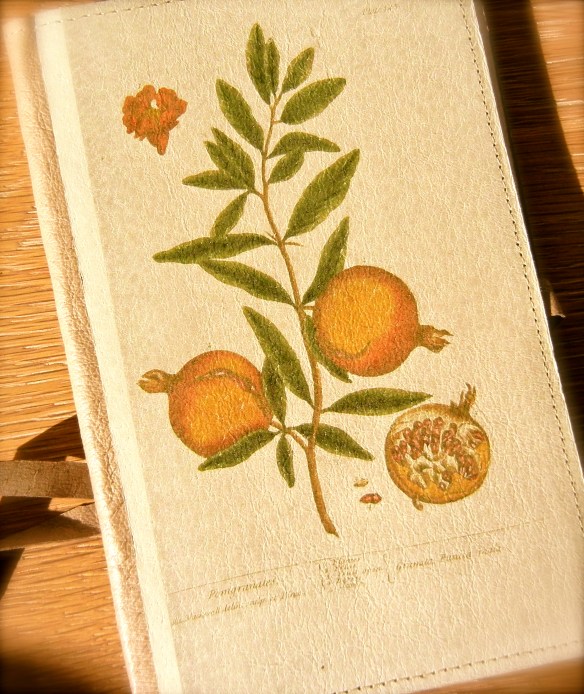
DSCN2337

The proprietor, whose name I’ve sadly forgotten, warned me that I’d never write in this book.

“No one ever does,” he said as he wrapped the small book in gold paper.  “But just so you know, I offer free refills.  When you fill this up, you send me a letter and I will send you more pages.”

“Oh, don’t worry, I’ll fill it up. I’m a writer.”

He nodded sagely, patted the package before he handed it to me.

“You’ll be the first.”

I think of this – self-fulfilling prophecies and keeping track of journal notes –  as I bid my students a semester’s-end goodbye.  They tell me they’ve turned into writers now and they want to know how to continue the practice.

Off the top of my head, I offer my own best advice.

* Write frequently, at least 1,000 words a day.
* Save your writing in documents titled by month and year.
* Take a journal with you everywhere. (Shhh, I didn’t tell them the story of what happens to mine.)
* Make a regular practice of transcribing your journal notes once a month. (Now there’s a thought.)
* When a new month rolls around, open a new document and begin again.
* At that time, make a regular practice of reading the previous years’ journal entries for that month. For example, every December I read all the December documents from previous years.
* And lastly, don’t ever let someone tell you that you won’t write.

I always miss my students, for their optimism, their tenacity, their freshness, and finally because without them I’d have no occasion to hear myself say aloud things I know to be true.

“Don’t ever let someone tell you that you won’t write.”

It’s time to face down the Pomegranate journal.

bare feet
low sun
blue in the afternoon

There. In pencil, with eraser marks, a far from perfect entry.  And then I remember my second favorite line from the poem “Twenty Questions.”

“Wouldn’t it be wrong not to mention joy?”

I scribble joy! in Pomegranate journal, just to remind myself.

Joy! I tell my students instead of goodbye.  And then, because a statement offers no possibility for dialogue, I ask a question.

Will you remember to look at the sky at dusk?

DSCN2182

With joy,
~ Catherine

P.S.  Jim Moore is an American poet and recent recipient of a John Simon Guggenheim Memorial Foundation fellowship.

He writes in the his fellowship profile about spending time in prison and learning that his fellow inmates were poetry lovers.

I discovered that a big notebook was kept secretly (passed from inmate to inmate so the risk was shared)  and at some cost (its discovery would have resulted in the loss of good time, which meant a longer stay in prison) in which inmates kept poems—poems of their own and poems by poets whose work they loved, mostly Black poets, but I remember Neruda was there, Whitman, and Longfellow, of all people.

You can read the entire poem “Twenty Questions” here.
 

Desire, expectation, and surprise

Autumn Afternoon

A startled flock of coots.
At once a chorus!  Wing beats rise upon the reservoir, soft like a stadium full of children wearing mittens.

I close my eyes. Can you pretend it’s angels clapping? 

(October 29, 2011)

I find this in my journal and decide to return to the reservoir this morning to snap a quick photo to illustrate my words so I can get back to today’s real task of beginning that novel I will write in a month.

An overcast sky creates a muted light, fitting for this day-after-Halloween hush hanging palpable as the clouds. We pass a few smashed pumpkins and I pick up empty Three Musketeers, Peanut M&M and Snickers wrappers that I find littered along the way.  They crinkle now when I reach into my pocket to grab the camera before we crest the ridge to the reservoir overlook.

Chester pulls on his leash. He’s not used to being confined out here but I don’t want him to  dash into the water and scare the coots like last time before I can focus on:

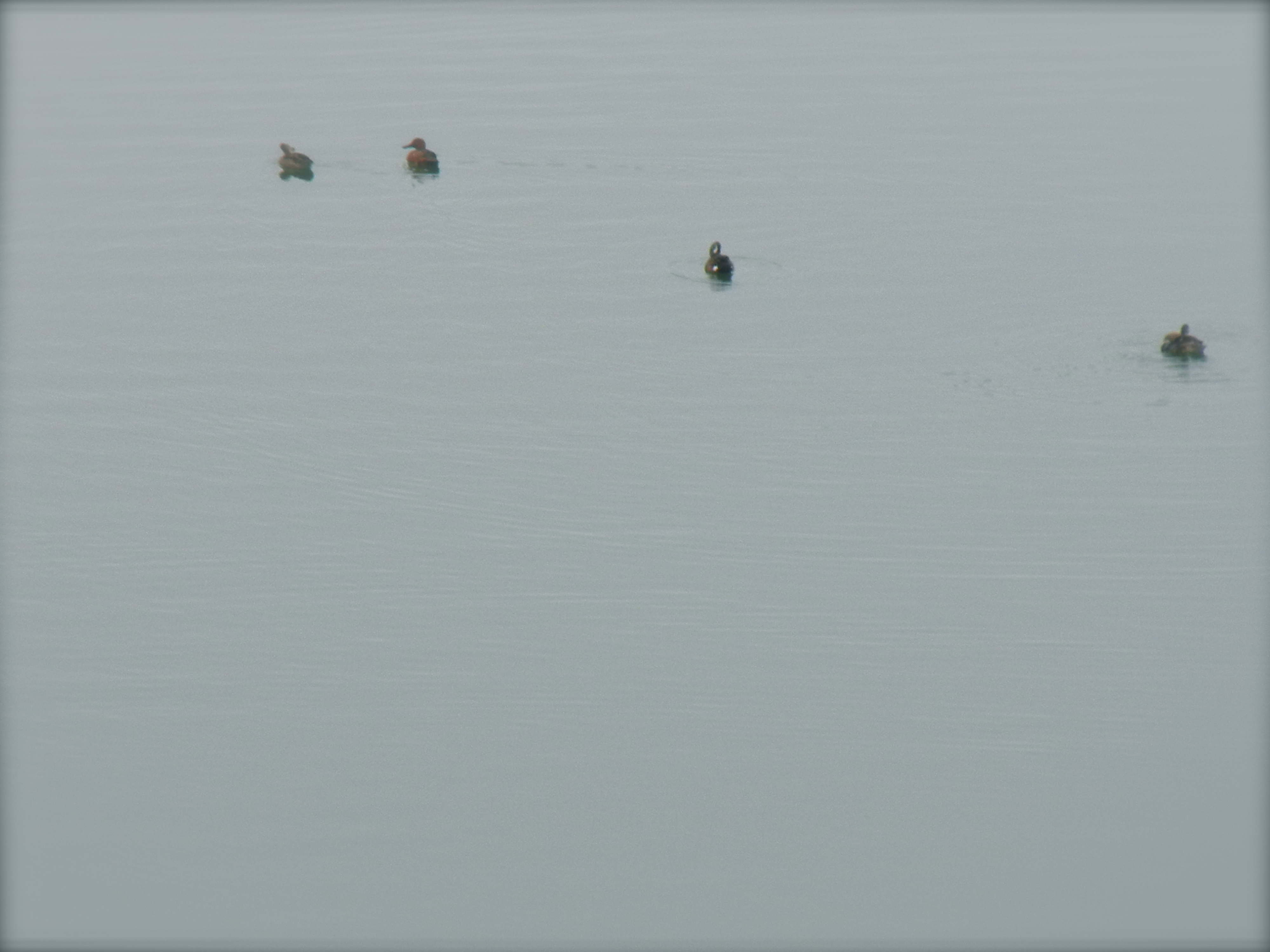
Four unruffled ducks, utterly unconcerned about our arrival.  Aren’t I a lame one. I should have known better than to expect a repeat performance from something as serendipitous as an entire resting flock of coots which flapped away to my poetic enjoyment.

I give myself permission to skip writing a post today and decide to return quickly home when streak of white flashes on the far shore.

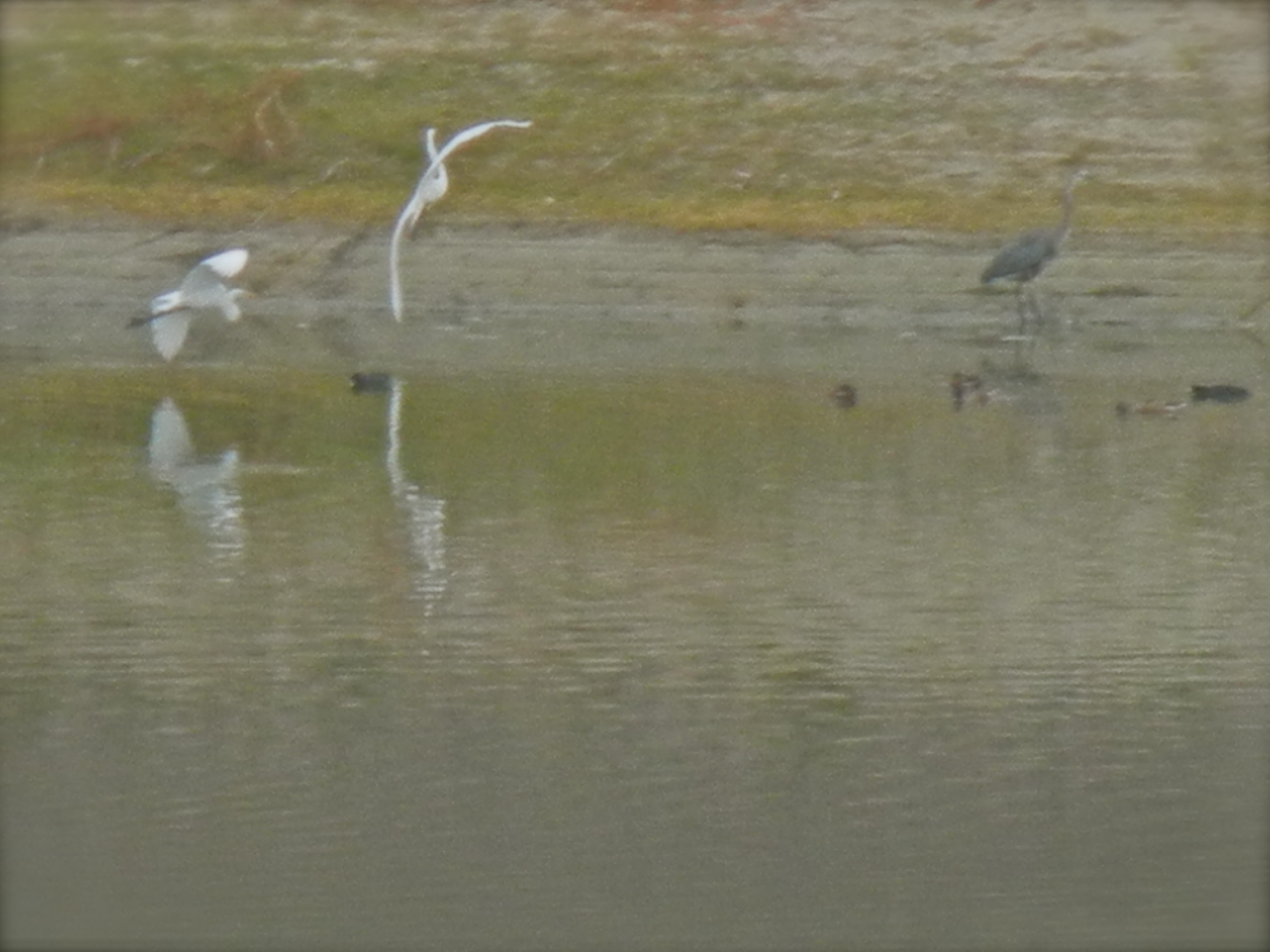
A heron! I’ll admit, I thought it was crane until I got home and learned that cranes fly with necks extended, while herons fly with necks held in a crook. Somehow I find great comfort in knowing that nature allows, in her wisdom for diversity, for both those who stretch as far as they are able in every single flight and those who keep their reach a little closer to their hearts each time they glide.

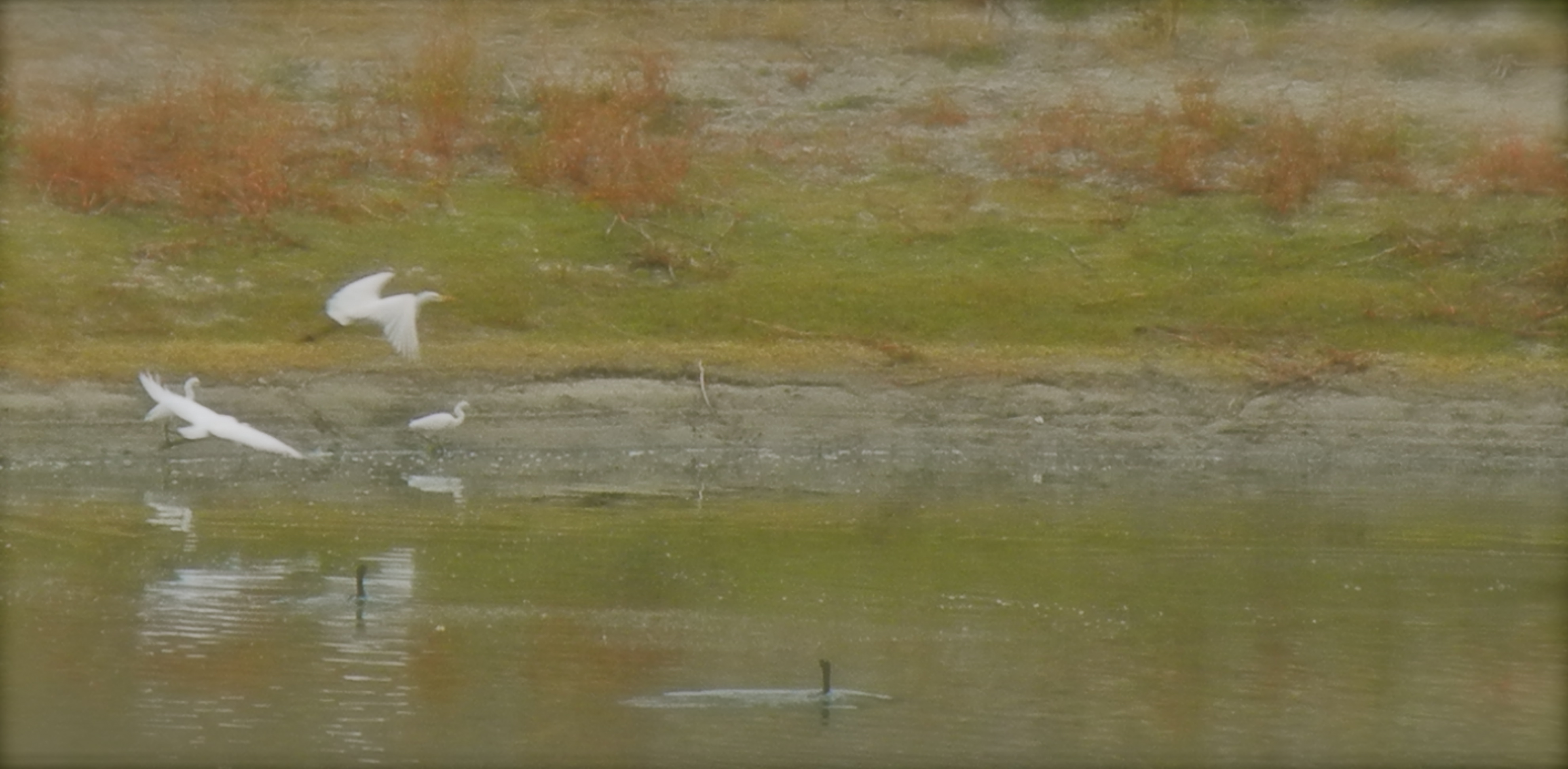
There in the distance are more herons, an egret, and yes, a few coots.

Chester sits on my foot. Is he telling me not to rush away? We pause and watch the herons swoop and drift and soar. There are no angels clapping but if I squint, it’s easy to imagine, on a day so fresh from memorializing death, that here at dawn we can witness angels flying.  Is this enough for one ordinary day?

We pull ourselves away.
There are words to write and “…miles to go before I sleep.” Chester is used to me quoting him lines of poetry when we walk.  For one brief moment he stops tugging on his leash. He looks over his shoulder and I swear he smiles.

With enchantment,
~Catherine

Time to dream

Dear One,

I see you standing there. I read your back and see the softened slump about your shoulders.

I hear your sigh that carries just above the shush of the Pacific, not quite a keen, but not a thing like laughter.  What is it you look for? Have you been waiting for so very long?

May I tell you something? Once I saw two boys barehanded fishing for tilapia in Kauai’s Hule’ia River. Frozen still in the shadows of the mangrove, they cupped their hands and waited.  Shhhh, they warned and I froze too, midstep on the hiking path.  All at once, like athletes on a pedestal, they raised their arms victoriously overhead and one wriggling fish flung droplets into the sky.

“Dinner!” they shrieked.

That night I dreamt I stood in the shallows of Hule’ia, hands submerged into murky water. I could not see clearly, unsure exactly what I was trying to catch.  I dreamt a cold plump softness nudging my open palms. One, two – too many sleek and slippery things to count – I grasped and missed, until at dawn I awoke empty-handed, staring blankly at the wall.

Is it like that now for you?

My friend wonders about her mounting “…sense of exhaustion and ambivalence…”

My students say, “This week is awful. It’s limp broccoli.”

It seems everyone around me is feeling…

when we would all so much rather be —

Here’s my Rx.  If you can, take a visit to your girlhood dreaming spot, or one that reminds you copiously of it. Gaze into the lantern of your inner fire. Catch the glow. Reflect the blaze.

Remember who you once were and what you said you would become.  It’s not too late. But hurry. You are waiting.  And so am I.
With vibrancy and gold,
~Catherine

p.s. If your spirits need a boost these days, stumble upon Dearest Creature by poet Amy Gerstler.  (You can read David Kirby’s New York Times review of it here.)

This is not a new book; it was published in 2009. But it’s a new discovery for me and I highly recommend any book that contains poems with titles like, “At the Back of a Closet, Two Dresses Converse” and “Chant of the Hallucinogenic Plants,” especially as an antidote if you’re in your blues period.  There’s no expiration date on golden poetry.

Five lines to challenge chaos

Is it possible to offset the apparent randomness of the universe?

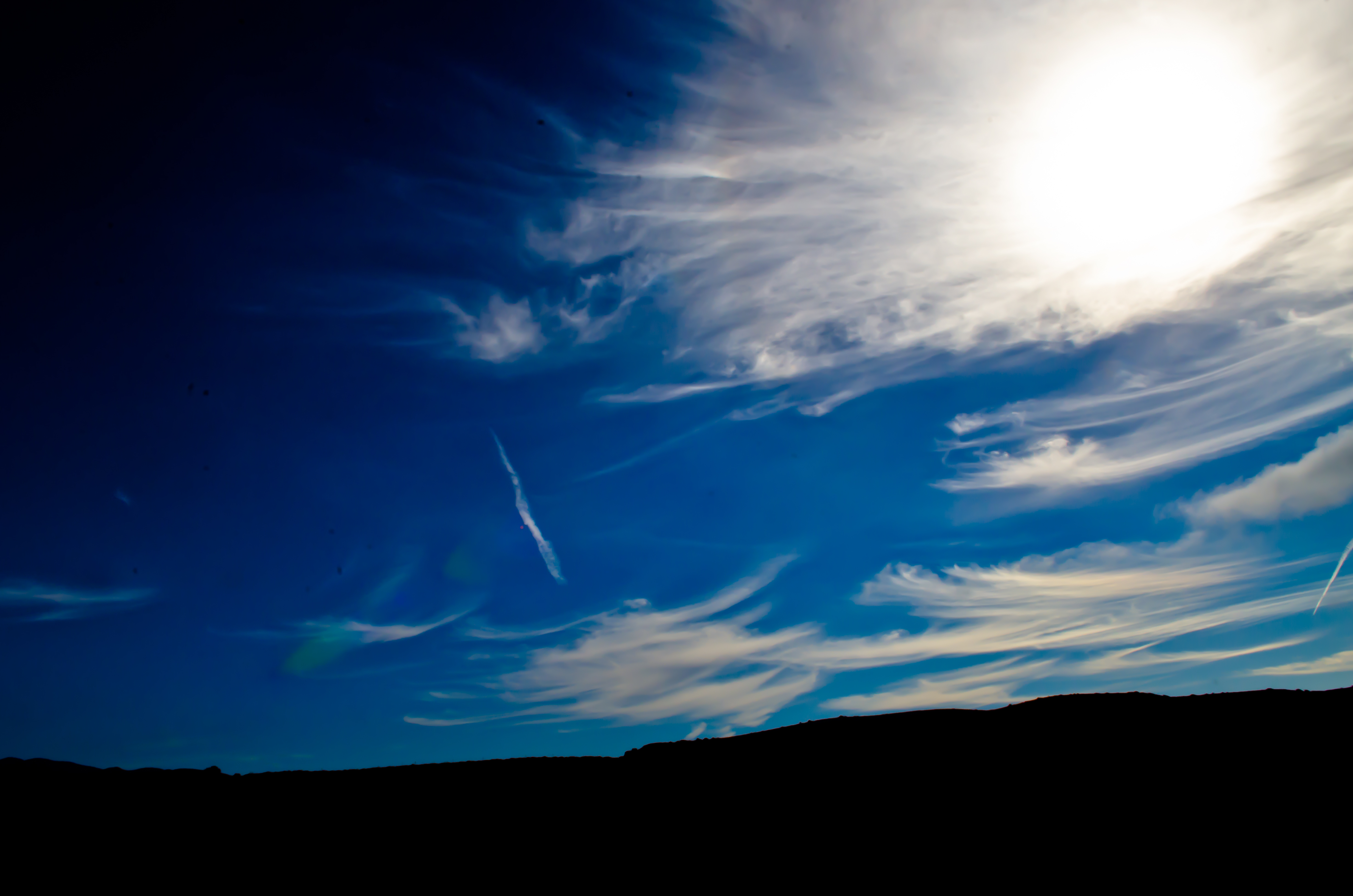
California Morning Sky.       Photo Credit: James Keefe Photography

Some ladies put up tomatoes, or peaches, or apple jam against the coming winter. I decide to create a stock of writing projects as sustenance against the lengthening darkness.  By spring, I’ll have a larder of poems that adhere to formal patterns found in nature, the sunflower, for example, or the whorl of a seashell, the number of legs on a spider for instance, or the swoop of an orb found glistening in early morning.

The idea takes root as I introduce my students to poetic form and we discuss the state of poetry as a mostly formless country these days, flowing as it does so frequently in free verse.  What is found when form is lost? I prod.  What is gained when form is followed?

I ask this, of course because it’s a good beginning for an Introduction to Creative Writing unit on poetry. But the debatable merits of structured versus unstructured poetry are making headlines these days within the literary community and I want my students to understand the fray. Before you roll your eyes and wonder who cares outside of a classroom or a Paris garret, consider that poets have long considered themselves to be what the English poet Percy Bysshe Shelley writes “In Defense of Poetry” as:

“… the mirrors of the gigantic shadows which futurity casts upon the present; the words which express what they understand not; the trumpets which sing to battle, and feel not what they inspire; the influence which is moved not, but moves. Poets are the unacknowledged legislators of the world.”

(You can read Shelley’s essay in its entirety here.)

It’s this role of poets as “mirrors of society,” that most concerns William Childress, a noted poet and National Geographic photojournalist, in a recent letter to the editor of the Virginia Quarterly Review, a journal of Literature and Discussion.

“Is free verse killing poetry…A blind person can see that American society is in turmoil…shouldn’t poets be trying to change things instead of writing chaos-poetry or “woe is me” diaries? Who will read poetry when they can’t find a common bond in a poet’s writing? Who likes ruptured grammar, twisted syntax and what my grandpa called flapdoodle? There’s at least a partial consensus that free verse these days consists of a lot of badwriting. I forget who said, “Poets should learn to write before they try to write poetry.”  Many of today’s poets don’t seem to realize that all writing is connected.”

All writing must be connected because all life is braided together in one way or another isn’t it.

As go the poets…
As go the canaries…
So go the humans?

Does nature, I ask my students, follow predictable patterns?

“No,” says the student who arrived late for the semester because Hurricane Isaac interrupted her flight plans from Florida. “It’s random and unpredictable.”

“Of course,” answers the biology major who cites genus and species classifications as one example of nature’s way of behaving according rules.

“Does art that most mirrors nature create more of an impact than art which seems more artificial?” I prod, quoting the philosopher Pseudo-Longinus‘ line about finding sublimity.

For art is perfect when it seems to be nature, and nature hits the mark when she contains art hidden within her.”

My students and I decide we’ll compose one sample of as many structured poetic forms as possible before we write any more free verse. We’ll read deeply from poets who follow form and from poets who made their break with form for reasons buried within the poem itself. We begin small, with a tanka, “a thirty-one-syllable poem, traditionally written in a single unbroken line. A form of waka, Japanese song or verse, tanka translates as “short song,” and is better known in its five-line, 5/7/5/7/7 syllable count form.”

Here’s my tanka-in-progress:

What one spider knows
spinning glass in dawn-dark fall —
even leaves let go.
Brilliance against the barren
this alone.  Can I believe?

Wishing you enough chaos to unsettle and enough structure to soothe,
~Catherine

p.s. Care to join our writing challenge? Up next is the cinquain, a five-line poem with 22 syllables broken down, according to lines as:  2, 4, 6, 8,and 2.

What do you call it?

“Do you know Pablo Neruda?”

My friend asks this after dinner on a Thursday evening of no occasion except that she, her husband, J, and I  felt a hunger to dine al fresco in the middle of the week before summer withers.  We’re old vines, the four of our lives entwined by years of shared joys and sorrows.

Her question surprises me; she’s not a writer, nor a particularly avid poetry reader.

But it’s been the kind of day that has offered odd moments.

The first bit arrives this morning while I walk down a pocked country road, Chester padding quietly by my side. The sound of an engine climbs the hill behind us, initially at a roar, then it slows to almost idling.

I hear the sound veer to the side of the road we’re on which means it’s now facing  oncoming traffic, if there were any. The rumble paces us , accelerates, and a white truck appears.

“Here.”

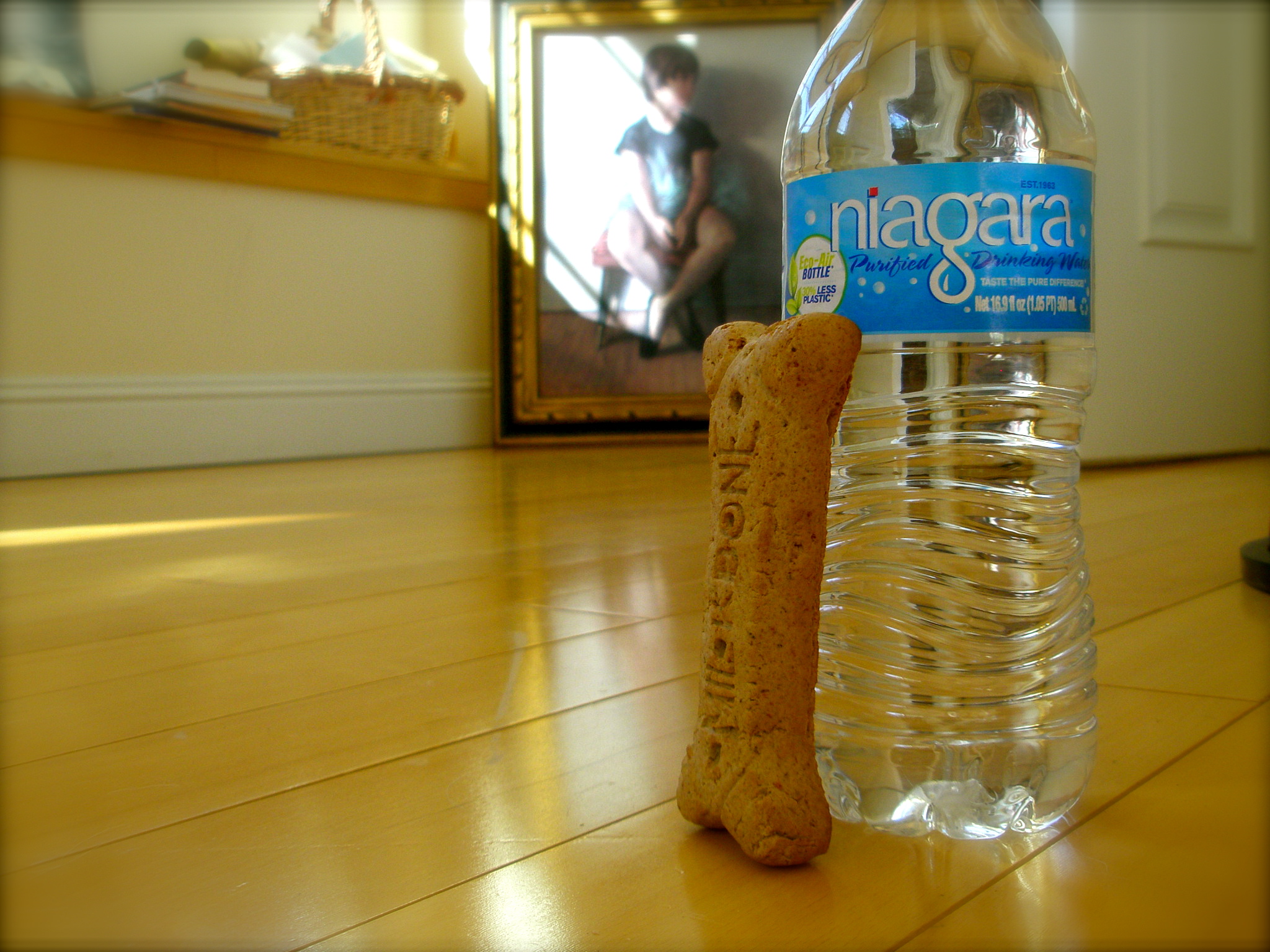
A middle aged man with a white cap pulled low presses a giant brown Milk-Bone dog biscuit into my hand. His truck is that close.

“Rod’s Pool and Spa Service.” I remember this in case I need to give a description.

The man thrusts his cell phone into my face.

“These are my dogs. I used to have big ones, but now I can only take care of the little kind.” A picture of several small brown dogs stares back at me.

“Your dog sure makes me smile. Thanks for that.”

I wonder at this biscuit, clumsily slip it into my pocket. I wonder at myself for running the mental bases:

Don’t talk to strangers
Don’t take things from strangers
Don’t eat things that strangers give you.

The man’s hand waves slowly out the driver’s window as Rod’s Pool and Spa Service wheezes off.

At home, the bone sits on my desk.  I can’t decide the bigger crime: throwing away a gift, or potentially poisoning my dog.  You see the cliff edges I walk.

That would have been enough for one day. But then it’s three in the afternoon and I’m walking alone with Chester down my own street. No other walkers are about on this bright afternoon.

I hear the sound of a diesel engine straining up the hill behind me.  I move out of the way.   The driver of a large water delivery truck pulls his vehicle into the wrong lane; he idles next me.

“Here.”

This young man with a deep tan hands me a bottle of water.

“That’s a great dog.  I used to raise Labs. I had a red one and a black one and they’re great dogs. He, yeah, that’s a he, yeah, he might get thirsty. Give him this water from me. Hi puppy. You’re a good fella. You made my day!”

The water deliveryman idles and oggles Chester until a white Honda pulls up behind and honks because the road is narrow and the truck straddles both lanes.  With a belching boom of a horn and a jaunty wave, the water delivery truck rolls on down the hill.

I set both items on the floor so I can photograph the evidence. Trust comes so hard for me.

I almost wait for a third encounter.  This has never ever happened before.  I wonder if it’s a creepy kind of day.  I’m a writer after all, and I know about things like foreshadowing and the literary Rule of Three that makes stories like “The Three Bears” a model for how to pace your plot or test your characters in a structure readers intuitively expect. Things happen in threes.

But I don’t want to be late for the dinner where I’m now retelling the story I’ve dubbed Strang(er) Thursday.

“Do you know Pablo Neruda?”

My friend asks this when I finish with the water man story and laugh all this off like it’s every day that a cast of weird strangers arrives to set me on guard.

“Yes,” I say. “I’m a huge Neruda fan. Twenty Love Poems and a Song of Despair. And then of course The Sea and The Bells and The Book of Questions. Why?”

My friend slides a piece of paper across the table.  “I found this in a magazine and it reminded me of you.”

“Take bread away from me, if you wish,
take air away, but
do not take from me your laughter.”

It’s an excerpt from “Your Laughter.” This friend has had a very difficult summer, the kind that is impossible to fix so the only thing to do is eat under the stars sometimes and tell funny stories.

“I love your laugh,” she says.

“What?”

I look up; think I haven’t heard her correctly. Clanking dishes, mostly spoons clatter against saucers and forks scrape hot fudge off plates at this hour when the candles are almost burned to the end.

“You have a great laugh. It makes me so happy. I treasure you.”

Oh, I think, and I burst out laughing, even though I’m now quite self-conscious about it,  but I  can’t help it because the Rule of Three is real in the universe, and therefore by extension literature, and this is Three Gift Thursday.  Nothing strange about it after all.

We return home and I feed Chester the biscuit. We sleep as if the universe rocks our cradle gently, gently.

With treasures and laughter,
~C

Dancing as fast as I can

My life has been the poem I would have writ
But I could not both live and utter it.

Henry David Thoreau said perfectly what I would have said if it hadn’t been the kind of week it’s been.

Apparently “they” were right when “they” told me, “If you switch to full time teaching, your writing time will suffer.”

A bow to you, almighty “they.”

A vow to me to dance faster, faster.

In praise of brevity and wisdom,
~Catherine

The Weekend Dish

The slow paddle toward change has already begun.

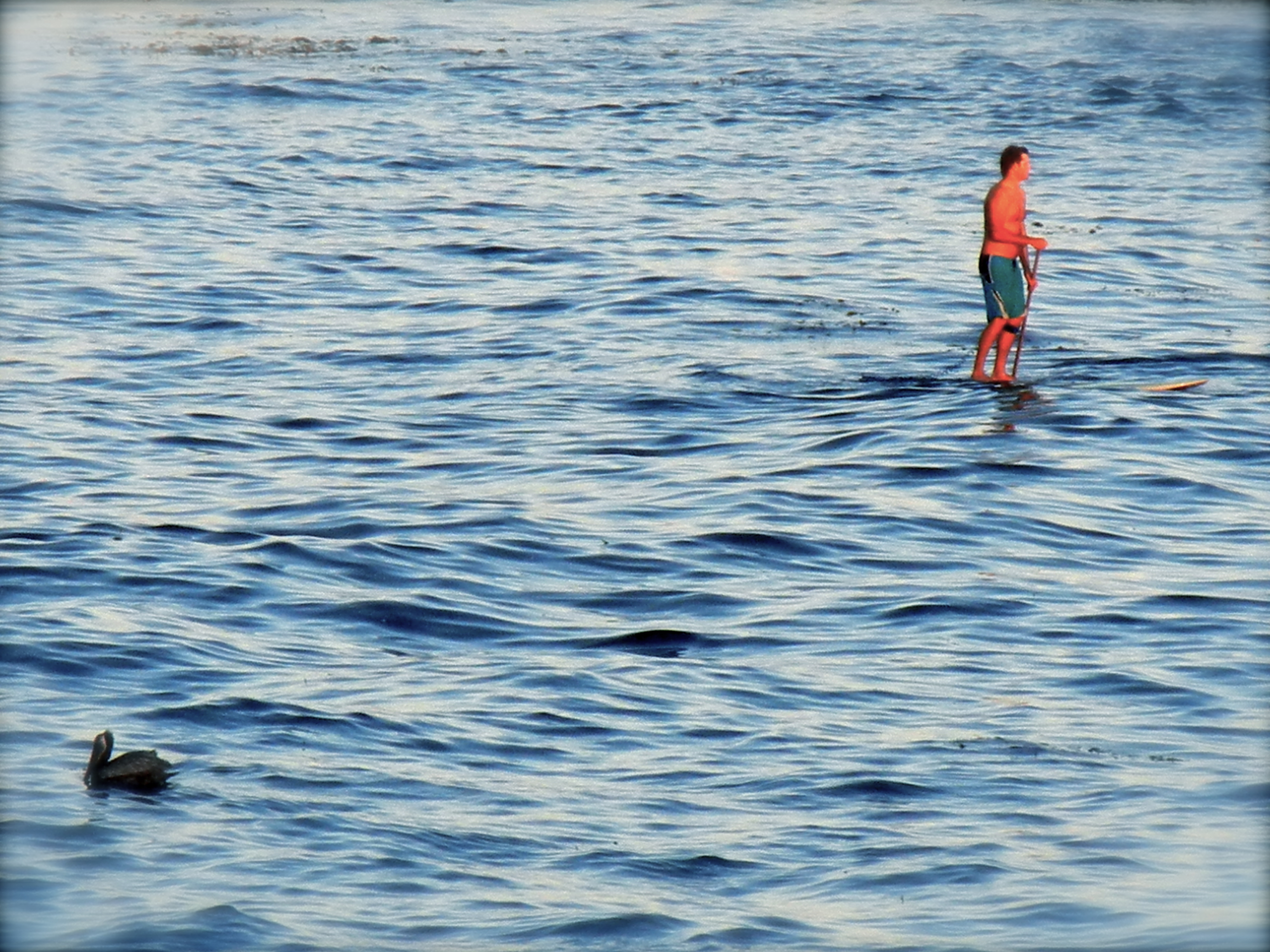
Diver’s Cove, Laguna Beach, CA

August traditionally means the warmest ocean waters of the year here in California, along with ripening figs on my backyard tree and plenty of afternoon sunlight for long bike rides.  But it also means a new slant in the shadows that whisper a shift toward that inevitable, all too soon, glide toward the golden fall.

Chautauqua Park, Boulder, CO

When I look at my calendar, I see 24 more days left of summer vacation, but I this month also holds the day that school begins and I must return to the classroom to face dozens of new writing students.

If this time of year incites a yearning in you to return to school to hone your writing craft, but you’ve got no intention of beginning any sort of long term program, have you ever thought about embarking on a long learning weekend?   If poetry is your thing, I’ve got just the right event for you to consider in New York City.

Attend The American Academy of Poets 2012 Poets Forum from Thursday-Saturday, October 18-20.  There are no entrance exams to worry about and no minimum GPA requirements to sweat over, just some good old fashioned immersion into poetry and a little bit of planning on your part if you don’t live in the city.

Check out hotels.  Look for flight deals.  Act soon. If you register before Sept. 1, you get an all-events pass to the full three days of events for $95.  This includes readings by poets like Toi Derricotte, Naomi Shihab Nye, and Arthur Sze, and panel conversations like “Poetry in the Age of Social Media,” and “The Anxiety of Audience: Who We Write For, Real & Imagined.” There will even be poet-guided walking tours where you can “walk the same streets traversed by Walt Whitman, Marianne Moore, E. E. Cummings, Langston Hughes, and countless other poets. These poet-guided walking tours will explore the literary history of Harlem, the West Village, the Museum of Modern Art, and SoHo.”

For a full schedule of events, clips of past Poets Forums, and a link to purchase tickets, click here.

Embrace the summer, but remember what follows the long days of sun.  If your inner student begins to hunger, find ways to nourish the craving for wisdom.

With more sun than shadows,
~Catherine

The Weekend Dish – Creeping Crust Cobbler

… A Creeping Crust Cobbler Recipe and story

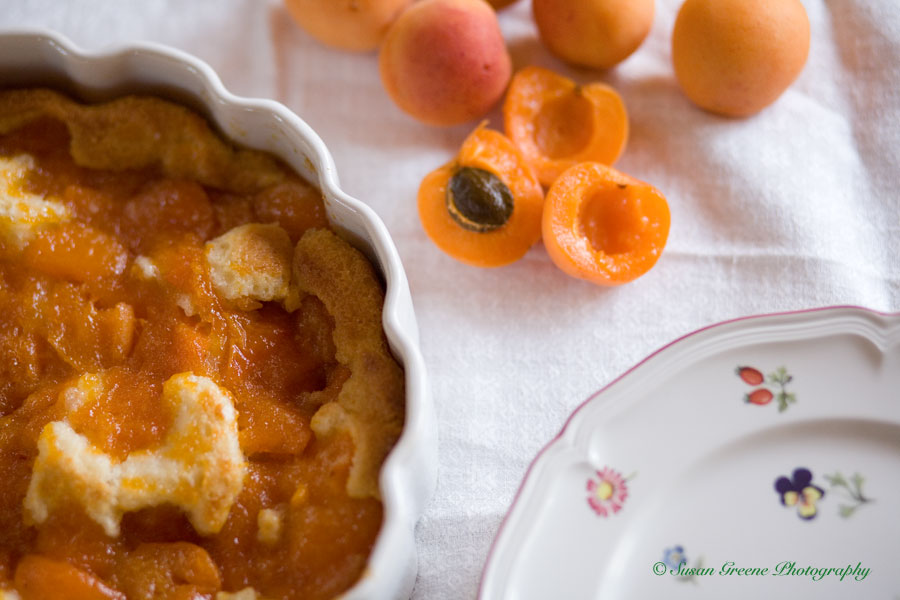
Apricots, like most good things, require patience.  The tree stands barren through winter’s chill while you are left to remember and dream, to wait and hope the small fruit arrives by the buckets come summer.

There are many things like an apricot.

Crystal Cove, CA

 A California sunset, for example.  Or, as Deborah Slicer writes in her poem, “Apricot,” “The weight of a small child’s fist, / a girl…”

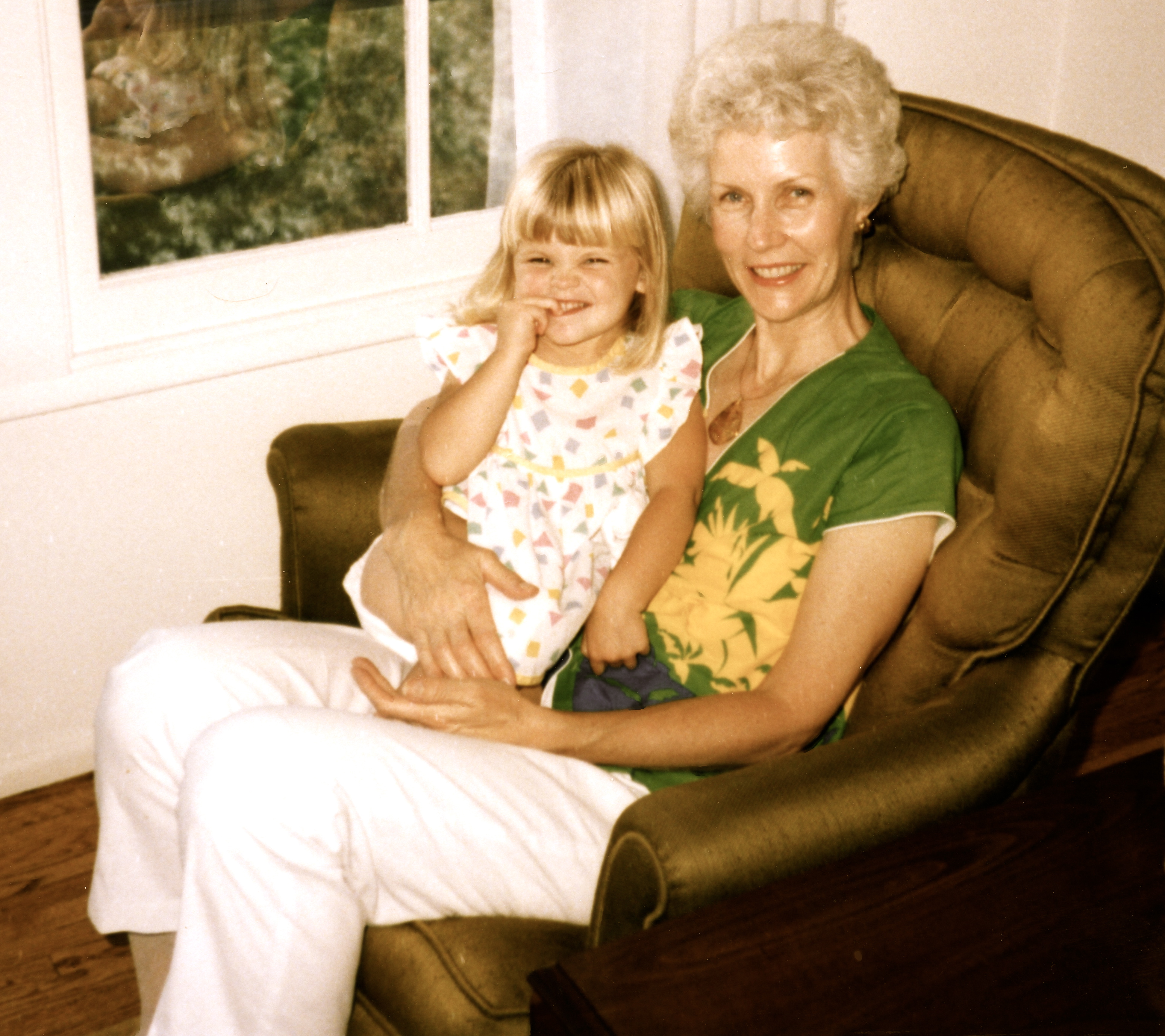
Apricot Girl with her Nana who made the family’s first Creeping Crust Cobbler.

In our family it was a girl who inspired Nana, the Backyard Sisters’ mom and grandmother to 10, to turn a bumper crop of apricots into Creeping Crust Cobbler, now a summer dessert staple in all the sisters’ homes.

It was the blazing hot summer of 1987 and Nana had come to stay with Catherine who had just given birth to a son.  Nana made a tradition of spending a week with her daughters whenever a new baby was born. One of the joys of this time was getting an extended visit with the older children in the house, and one of the Apricot Girl’s favorite things was picking up fallen fruit from the ground.

Apricots were one of Nana’s favorite fruits and she knew there was something better to be done with this backyard gift than throwing them for Max the Golden Retriever to catch.  “Let’s turn this into something delicious for dessert.”

When Nana asked what sort of cookbooks I had, I pulled out one that her own mother, Gammy to us sisters, had given me as a wedding shower gift.  A Collection of the VERY FINEST RECIPES ever assembled into one Cookbook was exactly the kind of book to find a homey recipe for apricots.

Gammy loved buying cookbooks from church groups or school PTAs and this book was a compilation of a fund-raising cookbook publishers best recipes.  It perfectly captured the sort of mid-western American fare she made most frequently.  Turns out, I put the right tool in the good cook’s hand. On page 189, Nana found a recipe for Creeping Crust Cobbler.  We’ve tweaked it a little over the years.  But there’s one thing that’s never changed; I always remember the summer Nana and the Apricot Girl discovered one of the favorite desserts in the entire Backyard Sister family.

CREEPING CRUST COBBLER
Heat oven to 350.

1/2 C butter
1 C flour
1 C sugar
1 t baking powder
1 t salt
1/2 C milk

1 C, or less, sugar.
2 C fruit  We’ve successfully made this with apricots, peaches, plums, and blueberries, or any combination of them all.  You can use the fruit solo or mix together. I usually don’t peel the fruit, but you can if you like.

– Heat fruit with sugar in medium saucepan over medium heat until sugar melts and thickens a little.

– Melt butter in 10-inch baking dish by setting dish with butter in it in heating oven.

– Sift together flour, sugar, baking powder, and salt in medium bowl.
– Add milk and mix.
– Spoon batter in large glops over the melted butter. (Is there anything better than a recipe that uses the word “glops?”)
– Pour fruit and sugar mixture over dough.
– Bake in 350 oven about 30 minutes, until crust is golden brown. (Sometimes this bubbles over into your oven so you might want to place the pie pan on a cookie sheet.)
-Crust will rise to the top.  Serve warm or cold.

Superb with a dollop of ice cream. Excellent for breakfast.

With sweetness,
~ Catherine, Sue, Gammy, Nana, and the Apricot Girl

p.s. You can read Deborah Slicer‘s poem, “Apricot,” in its entirety on the Orion magazine website hereOrion is a treasure for anyone interested in nature meets literature meets culture.

“Stop this day and night with me…”

This hour I tell things in confidence,
I might not tell everybody, but I will tell you.

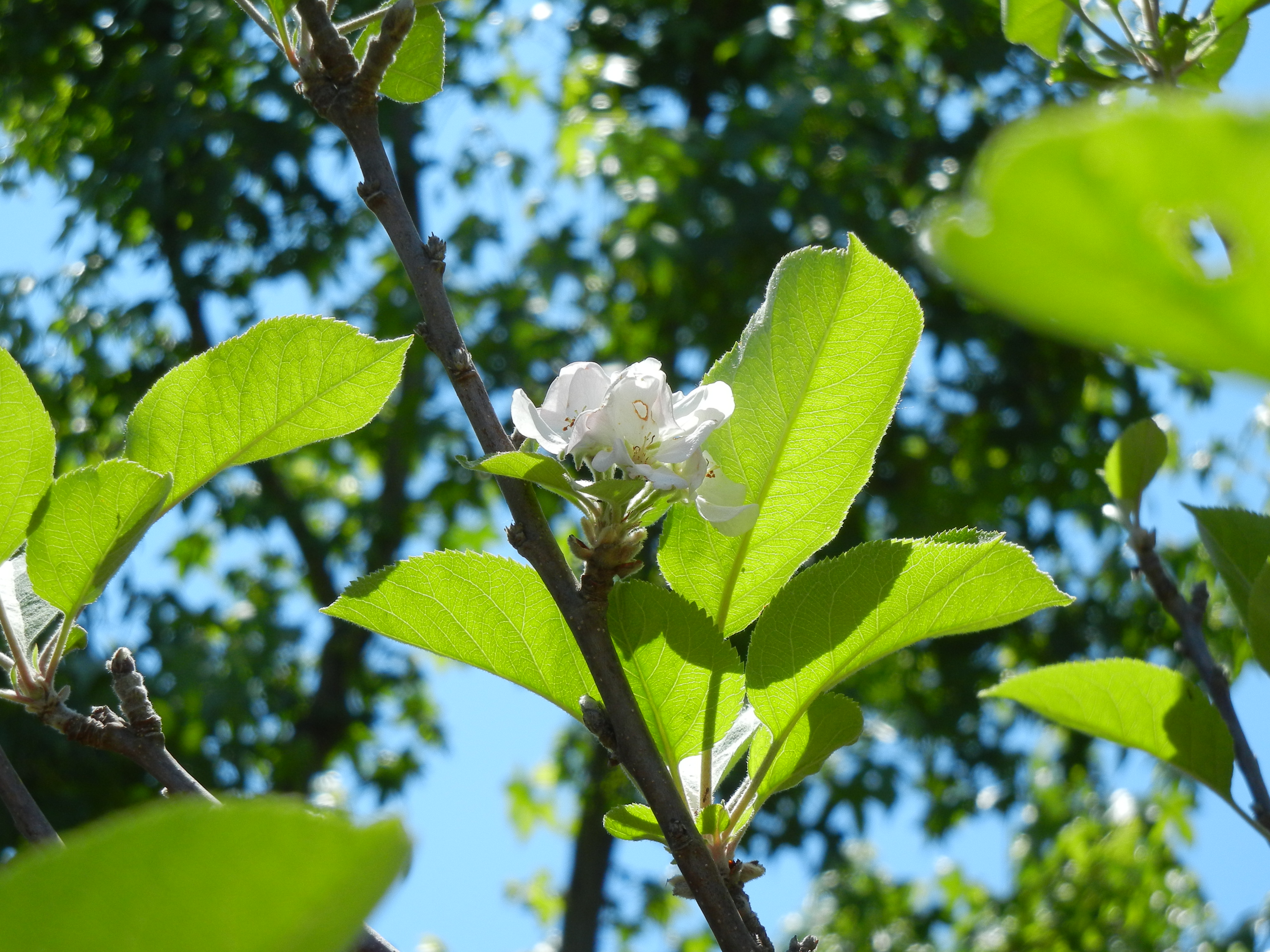
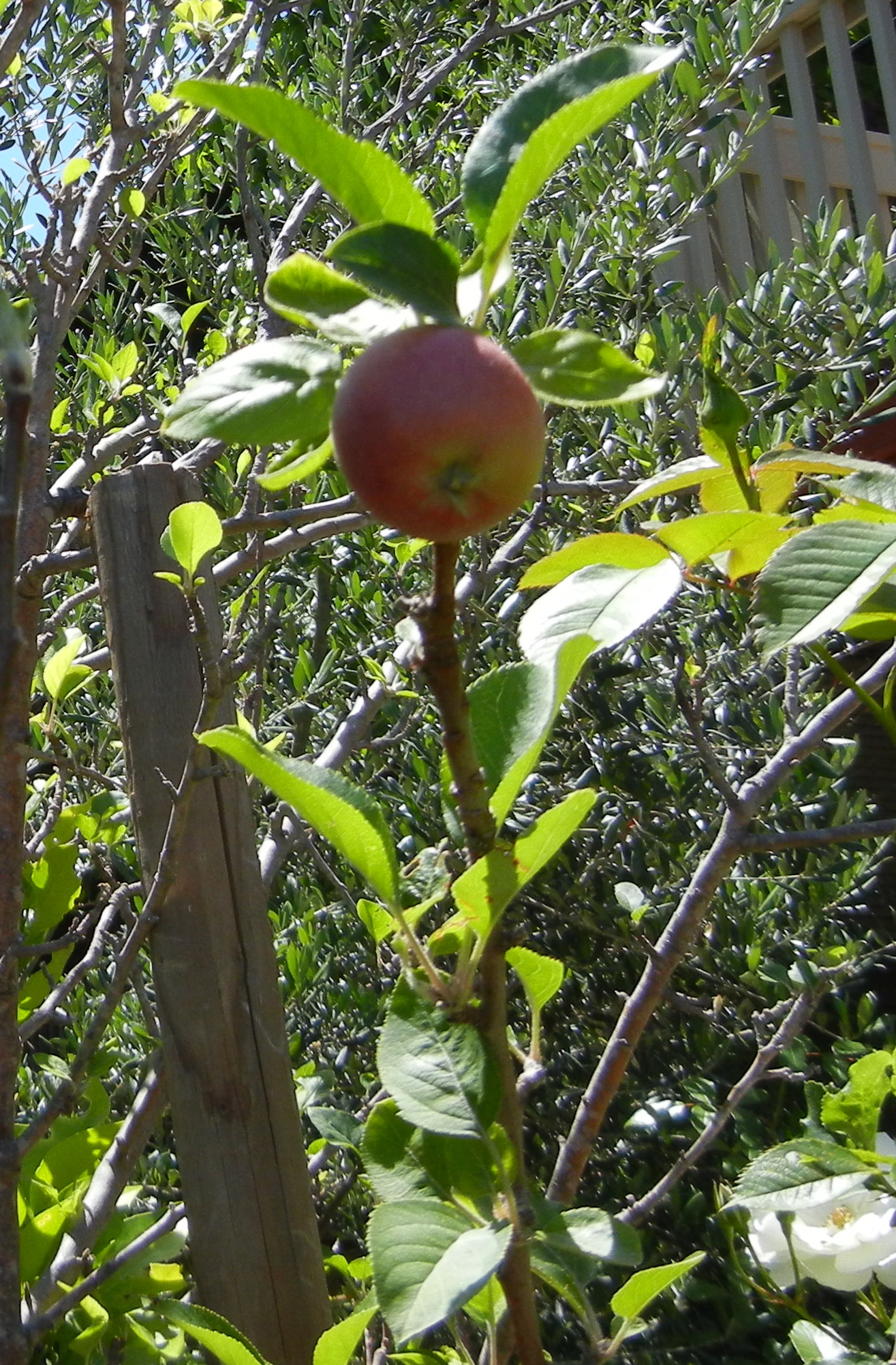
Angel’s Apple Blossom

I saw Angel today.

He sat slumped in the driver’s seat of his sagging brown truck in the General Store parking lot at ten in the morning guzzling beer from a 24 oz. can.  His head waggled and seemed disjointed from his neck. His red eyes blazed. When I jumped out of my car and tried, after all these years, to finally thank him he waved me away with a wobbly hand.

“No, no, no.”

What is a man anyhow? what am I? what are you?

I had hired Angel one winter to mow my grass and pull weeds, to prune my roses and feed the orange trees. He did those things sporadically and not very well.  His strength was drinking beer and surprising me with gifts.  His specialty was to plant what appeared to be utterly dead fruit trees in my yard.

“The other house, no want,” he told me the first day I came home to find a bony trunk with naked branches staked on the fringe of my grass.

“What is it?” I asked.

Angel spread his muddy palms to the sky and shrugged.

“Fruit.”

“What kind of fruit?”

He spread his muddy palms to the sky and shrugged.

Slowly a patchwork orchard emerged in my backyard. Angel murmured to the branches as he hand watered the circles of dirt around each tree.  When he caught me watching him, he smiled broadly.

In all people I see myself, none more and not one a barley-corn less,
And the good or bad I say of myself I say of them.

“Is it alive?”

Angel nodded, always yes.

“What kind of tree?” He spread his muddy palms to the sky and shrugged.

Each tree ignored my need for it to prove its place by greening, then blooming on any proper schedule.  I researched the rhythm of bare root fruit, but spring didn’t bring an end to the mystery.  The trees remained unfazed as earth turned toward blooming season.  I stopped inspecting the branches after a while and began instead to consider how hard it might be to pull up dead trees.

Then one damp night I was restless and wandering, wanting stars.

Solitary at midnight in my backyard…

Angel’s first tree shimmered in the moonlight.  I walked up to it and swear I heard trumpets. What I had missed all those days, looking from afar at the branches barren of leaves was the riot of ruffled pink popcorn pearls pinned on slick branches. Tight blossoms were poised this night to begin a wild unfurling.

Peaches?
Apricots?
Nectarines?

What could I imagine eating sun-warm some months from now?  What might I capture in jam jars to tie with red gingham?

Earth! you seem to look for something at my hands,
Say, old top-knot, what do you want?

The next time I saw Angel and showed off our blossoms he smiled, more bemused at my excitement than joyful for the harvest. He never doubted fruit would come.
A peach tree.
An apple.
An orange.
Another apple.
A plum.
An apricot.

For seven years Angel tended our slowly growing orchard.  His faith in the indiscernible life hiding within brown leafless branches scavenged from other yards was impeccable.  Then one day Angel stopped coming. Yet every now and then a new barren tree would appear in my backyard and I would look over my shoulder, half expecting him to be squatting at the base of the apple tree, his favorite spot, humming absently.

If you want me again look for me under your boot-soles.

I began to wonder if I’d imagined the man.  When he called himself Angel was that a name or his being?  I took over the care and feeding of the trees and silently thanked him with each basket of ripe fruit I brought into my kitchen. I shared the bounty with neighbors and told them about how Angel showed me that you could save a thing by moving it to the right home and tending it with water and words.  Was I creating a myth?

You will hardly know who I am or what I mean…

Today as I walk back to my car, rebuffed, I turn my palms to the sky and shrug.  Driving away, I wonder: If I could plant Angel in my backyard would he bloom again?

Angel’s Apple Tree

I exist as I am, that is enough…
Imagining you in health and sun,
~C

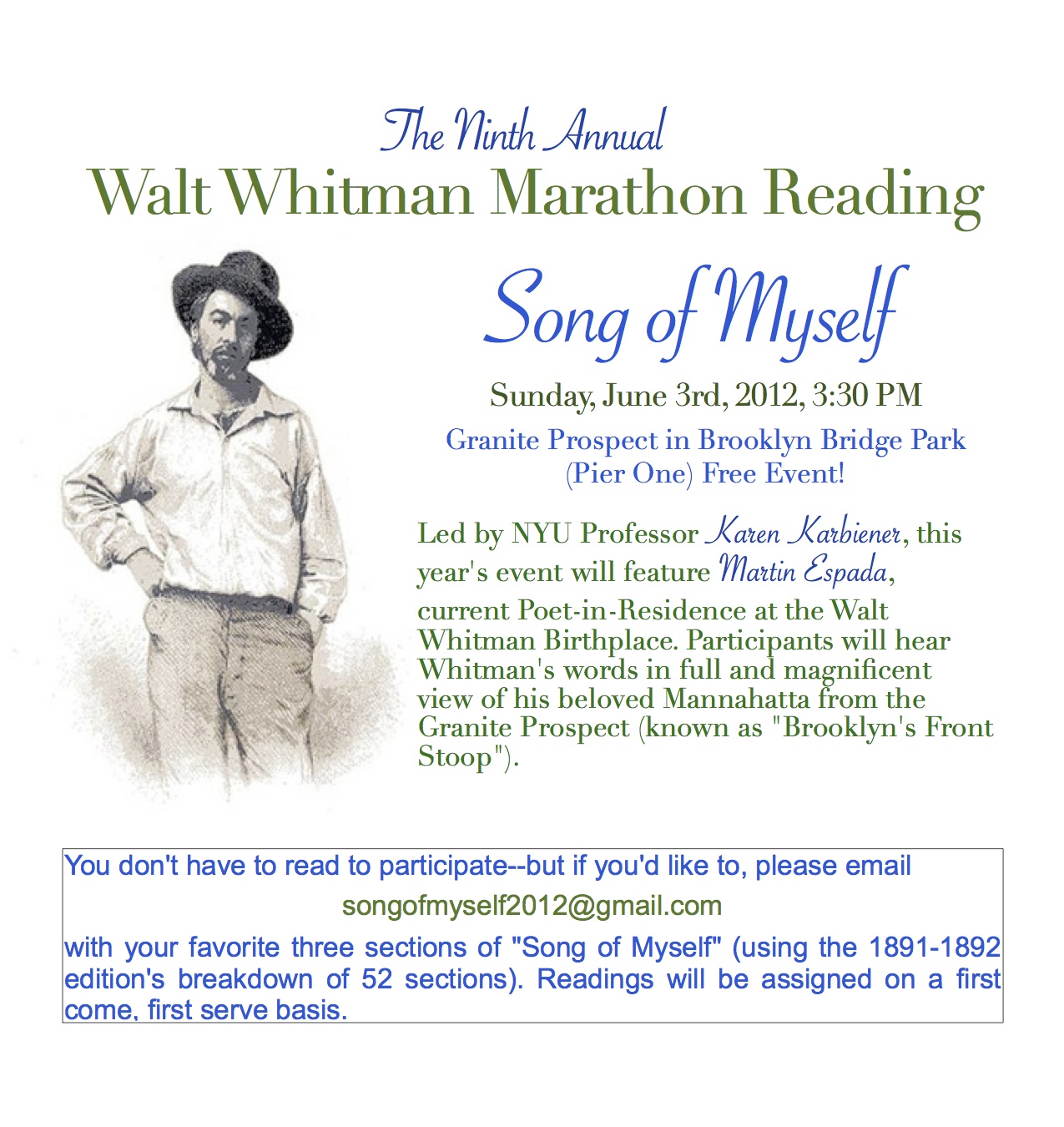
Note:  The words in italics come from Walt Whitman’s “Song of Myself (1881).  Today would be Whitman’s 193rd birthday.  If you’re lucky enough to live in or be visiting New York this Sunday, June 3, you can participate in the Ninth Annual Walt Whitman Marathon Reading of “Song of Myself.”  For more information about the man, the poet, or events at Walt Whitman Birthplace State Historic Site and Interpretive Center in West Hills, NY, visit http://www.waltwhitman.org/