Slip me some skin

By Catherine Keefe

Skin is the sole
thin veil between
where I stop
and you begin

baby

This sole thin skin is all
that keeps me
from melting into you

Slip me some –
Give me some –
You are under
my skin.

Be soft today.

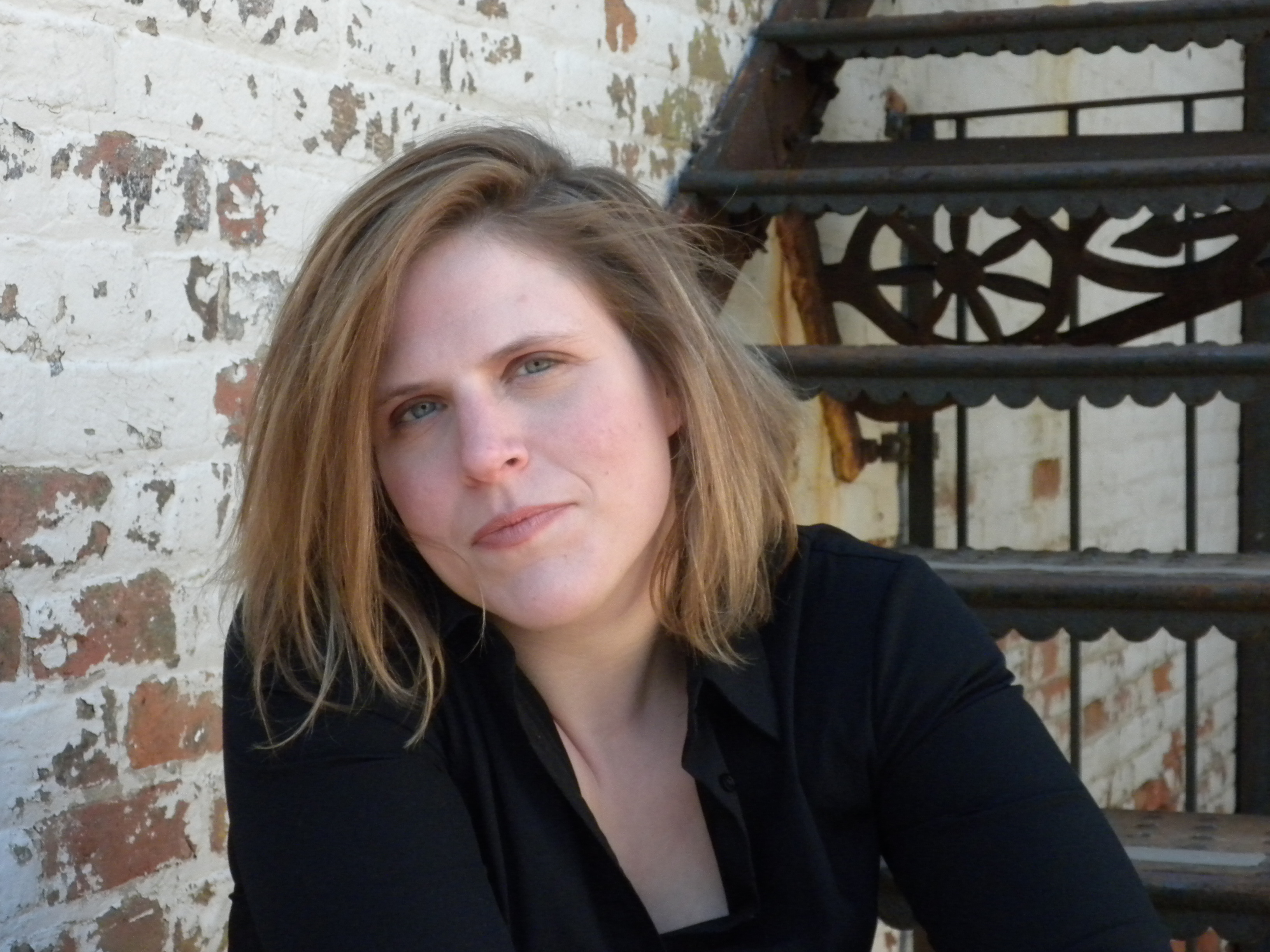
My grandchild’s face is the inspiration for Day #3 of The August Break photography challenge prompt, “Skin.” Follow #augustbreak15 on Instagram, Facebook, and Flickr for more images.

~ Catherine


“…out of doors is made up of air…”

gulls By Catherine Keefe

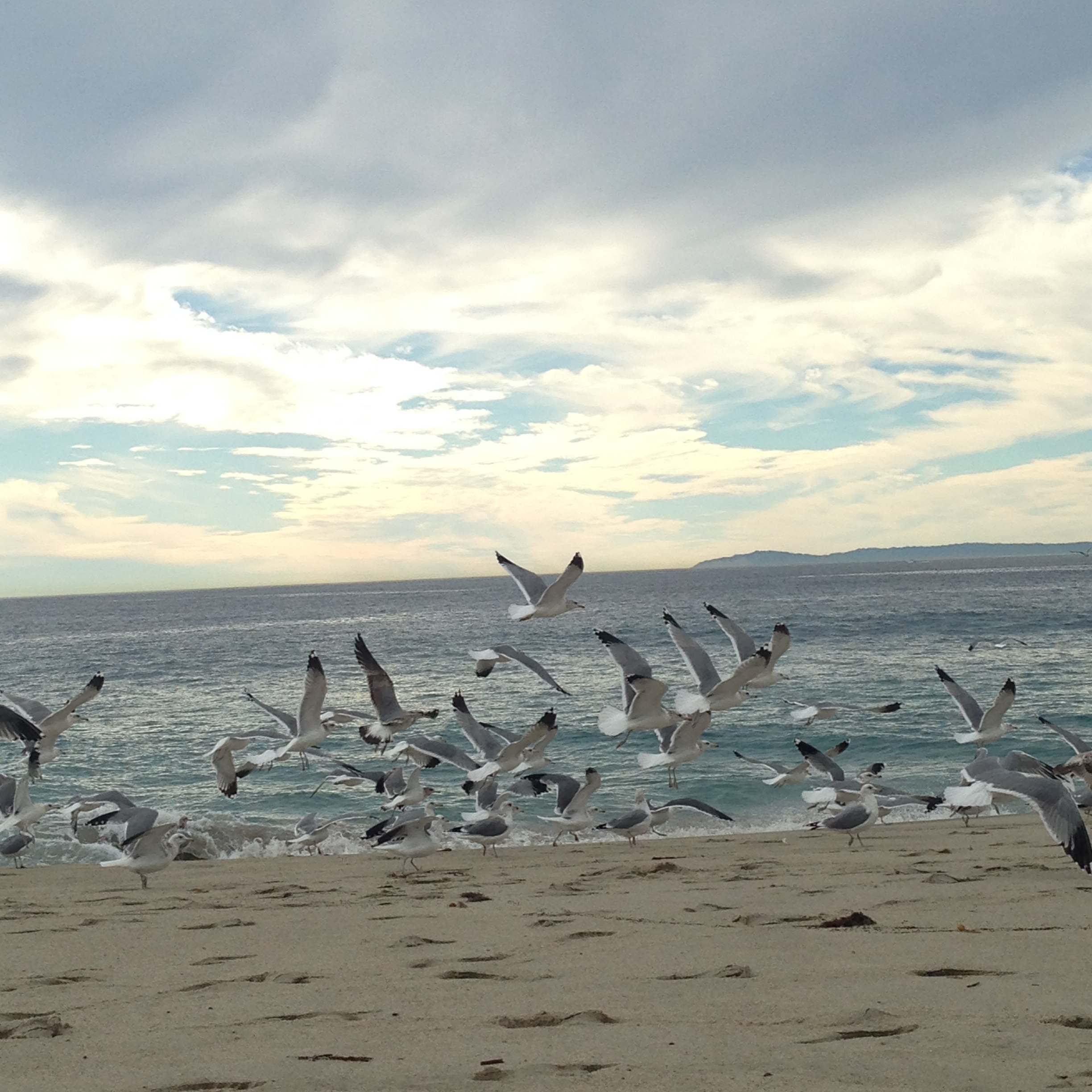
“…and a painting is always a flat surface, a painting has no air, the air is replaced by a flat surface and anything in a painting that imitates air is illustration and not art.” Gertrude Stein was rather firm in her opinion about the artistic effort of rendering air in her book, Paris France.  What bravado then, for me to attempt to photograph “air,” the Day 2 prompt for The August Break.

But then, I always like a challenge. I try the seemingly impossible in photography, “capture air,” or in writing when I take on Helen of Troy’s persona in my poetry manuscript.  Undertaking the difficult thing is the call of an artist. Gertrude Stein also wrote, “One of the pleasantest things those of us who write or paint do is to have the daily miracle. It does come.”

We seek that exhilarating moment when we capture the flash of life as art in momentary perfection. Usually the daily miracle comes by showing up and paying attention.

What you can’t see in my image of California Gulls on Laguna Beach is the little boy, just out of left frame, running down the beach in bright red trunks, flapping his arms in agitation at this flock that moments earlier descended on his towel and pilfered his bag of Cheetos. As the boy began running, I pulled out my camera to focus on the gulls.

Every day gives up its sparks if we show up to pay attention. One certain miracle of a summer Sunday is having enough time to spend outside. Put down your device, and go outside now! Chase birds, or chase your daily miracle. Chase your dream, or your lover, or your child.

Breathe.

Gulp great mouthfuls of air.

You are alive.
~Catherine

ps. If you want to hear one sound of California summer, check out the Cornell Lab of Ornithology California Gull Call audio here. For more “Air” images search #augustbreak2015 on Instagram, Facebook, and Flickr.

I could give a fig

figs

By Catherine Keefe

Breakfast.

California figs.

Figs are technically flowers, not fruit.

I eat flowers for breakfast.

California grows 90% of the world’s figs. This year there was enough water to grow these delicacies. Endangered by drought? Maybe. But today, there are figs. Rejoice!

And read a morsel of fig poetry by the indominatable Edna St. Vincent Millay.

First Fig
My candle burns at both ends;
It will not last the night;
But ah, my foes, and oh, my friends—
It gives a lovely light!

For more “Breakfast” images, check out The August Break, 2015 project inspired by Susannah Conway, a photographer we greatly admire over here at Backyard Sisters.  You can follow the month-long photo challenge to “Live inside each moment,” by checking #augustbreak2015 on Instagram, Facebook, and Flickr.

Happy August! ~Catherine

Sweet freedom

By Catherine Keefe

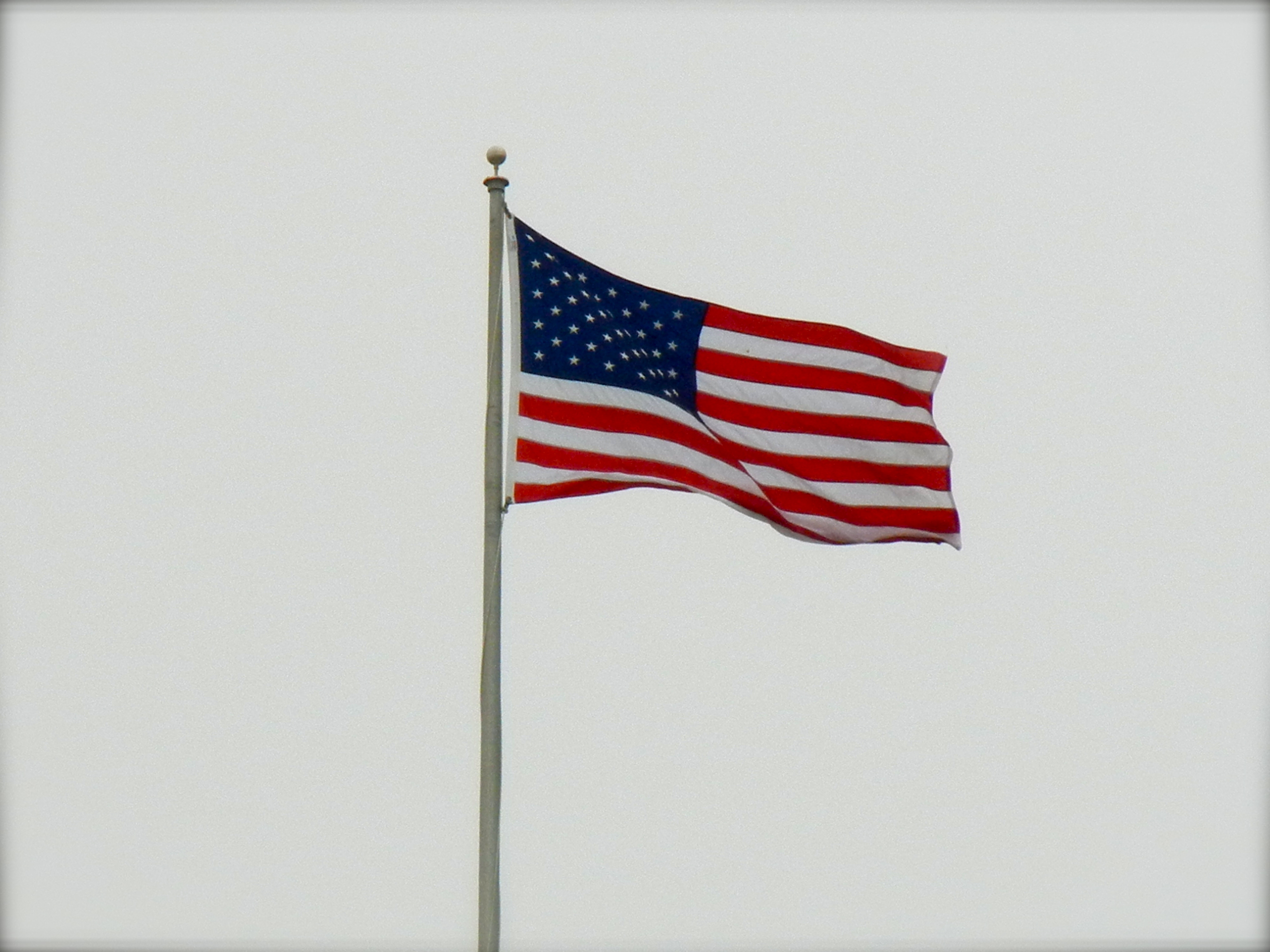
“Freedom: to walk free and own no superior…”
           Walt Whitman

DSCN3298

Today’s a perfect day to play with Walt Whitman’s poetry. The Poetry Foundation says:

Walt Whitman is America’s world poet—a latter-day successor to Homer, Virgil, Dante, and Shakespeare. In Leaves of Grass (1855), he celebrated democracy, nature, love, and friendship.

Whitman’s legacy is as a poet of the people and his poetry reveals optimism in the great democratic experiment that is America, one that I think needs a little shaking up these days.

Here’s one Walt Whitman original.

America
Centre of equal daughters, equal sons,
All, all alike endear’d, grown, ungrown, young or old,
Strong, ample, fair, enduring, capable, rich,
Perennial with the Earth, with Freedom, Law and Love,
A grand, sane, towering, seated Mother,
Chair’d in the adamant of Time.
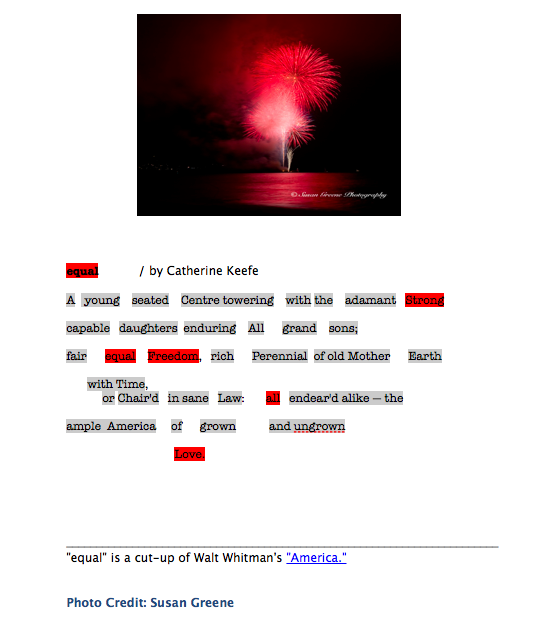
And my new poem: 

keefe-4

 ____________________________________________________

May your day be spent in the company of those who make you feel most free.
May your freedom be spent sweetly.

Happy 4th,
~Catherine


So much light lifting

Rise Festival, 2014. Photo Credit: Lauren Sepulveda

Rise Festival, 2014.                                                        Photo Credit: Lauren Sepulveda

By Catherine Keefe

Much has been said in the past few days about how 29-year-old Brittany Maynard died. I’d like to tell you a little bit about how she lived.

Brittany, with a passel of other girls, came to my daughter’s 13th birthday party. We invited guests to attend in their most fabulous feathery, sparkly attire, turned our living room into a mock casino, and created an at-home Vegas Night. I hired a 16-year-old boy from down the street as a Blackjack dealer, and it was at the Blackjack table that Brittany spent most of the night. She flirted while most of the girls were so shy they wouldn’t even talk to the only boy in the room. Brittany bet all her chips and won, then fluttered her red paper prize-redemption tickets like confetti across the room because that was more fun than trading them in for a tube of bubblegum lip gloss. Brittany sashayed through the party like a starlet, trailing feathers from her black boa. She sipped Martinellis with her pinky raised, and laughed more loudly than any other girl at the party. She was, as the invitation requested, fabulous.

To know a girl on the cusp of emerging adulthood is to look through a kaleidoscope and slowly turn the lens. Who she might become is a fractal of who she already is.

Brittany was light years ahead of the other 13-year-olds in the most important way possible. She had a way of living without paying any attention to what anyone else thought about it. She was strong at an age when many girls become weak. For that reason Brittany was the kind of girl a mother loved that her daughter would befriend. My daughter and Brittany remained friends until some time in the middle of high school when their interests and activities slowly diverged.

A little over a year ago, I saw Brittany’s mom, Deb, at Trader Joes in Rancho Santa Margarita. Deb was my daughter’s middle school science teacher, my own particular hero for the way she passionately engaged students with basics of geology, biology, and chemistry. It had been years since we’d seen each other so we caught up in the apple aisle about our girls’ college choices and career paths, marriages and our own lives.

“Brittany always does things her own way,” I remember Deb saying.

“And that’s why we love her,” I answered back, knowing that not everyone likes that trait in a young woman.

In the moment when I knew the chance conversation was almost over, I wondered if someone I’d lost touch with would believe how much she’d impacted my life by no more valiant feat than being her one true self and standing by her daughter when she too was being her one true self.

When you say it’s so good to see you and you mean it, and you hug and move on, and next read about Brittany and Deb in People magazine, life takes a surreal twist. When I wrote in April about my daughter’s friend, recently diagnosed with Astrocytoma Glioma, a malignant brain tumor, I had no idea Brittany would become “the public face of the controversial right-to-die movement.”

Oh how I’d like to hug Deb now, to tell her how much strength and love our family is sending to her in Oregon. How I’d like to remind every mother to hug her daughter a little more tightly just now. How I want to insist that everyone who has followed and commented upon Brittany’s story to remember Deb, a mom called to be braver and stronger than she ever wanted to have to learn to be.

A woman whose spouse has died is a widow; the girl who loses both parents is an orphan. There isn’t a designated word for a mother who loses a child. It’s a black hole in the language.

Rise Festival, 2014   Photo Credit: Lauren Sepulveda

Rise Festival, 2014                                                                 Photo Credit: Lauren Sepulveda

Some die like a candle snuff. Others expire as a sonic boom. Brittany died the way she lived, a meteor lighting up the darkest desert night sky. She was an only child, but there was nothing “only” about her.

She was, and will always remain, fabulous.

Cheers Brittany, dah-ling. You impacted our lives for the better and for that we’ll always be grateful. Thank you Deb, for sharing your Brittany with us. We reflect back to you all the light and love your daughter spread.

Peace,
~Catherine

Many thanks to photographer Lauren Sepulveda, another one of the passel of girls, who shared her images of The Rise Festival for this post. You can find more of Lauren’s images at Voz Collective.

Building community post by post

road

Writers work alone, it’s true. But it’s equally accurate that writers work in community once the word by word composition is finished. I’m thrilled for Backyard Sisters to be this week’s stop on The Writing Process Blog Tour by hosting a self-interview with Sara Henning.

sara picSara Henning is the author of the full-length collection of poetry A Sweeter Water (2013), as well as a chapbook, To Speak of Dahlias (2012). Her poetry, fiction, interviews and book reviews have appeared or are forthcoming in such journals as Willow Springs, Bombay Gin and the Crab Orchard Review. Currently a doctoral student in English and Creative Writing at the University of South Dakota, she serves as Managing Editor for The South Dakota Review.

Here’s Sara…
The Writing Process Blog Tour
Many thanks to Catherine Keefe for hosting my installment of the vastly circulating Writing Process Blog Tour on her Backyard Sisters Blog!

 What am I working on?
I’ve been spending the past few months promoting and reading from my first volume of poetry, A Sweeter Water, as well as continuing to promote my chapbook, To Speak of Dahlias (2012). Both of these collections concern suicide, paternal order and the trope of longing. The reoccurring image of the dahlia weaves in and out of the fractured narrative as both a talisman and a taboo.

I have had the joy as of late to have been interviewed about these books by Laura Madeline Wiseman, editor of the groundbreaking Women Write Resistance, an anthology dedicated to resisting gender violence, and Sally Deskins of Les Femmes Folles. A collaborative interview with Laura Madeline Wiseman regarding these collections is also forthcoming on the Sundress Publications blog.

I’m also working on a collection of poetry entitled What Women Won’t Tell You, which I envision engaging with poetry as a means of embodied resistance to hegemonic narratives through both post-confessional protest and lyrical meditation.

How does my work differ from others of its genre?
As a poet, my work explores issues crucial to the current contemporary moment. Most specifically, it tends to address the quiet war on women waged at home. In the wake of cases such as Ariel Castro and the kidnapping of Jaycee Lee Dugard, I brace myself for every time I watch the news. Every few months, another woman is found locked in a basement. Every few seconds, there is a woman suffering in silence. Now, if you will, pit this against the current state of poetry, with its focus on professionalization and bohemianism from within the ivory tower.

By writing work that engages with the current cultural moment, I’m trying to avoid being a McWriter.

Why do I write what I do?
Because I can’t help it.
Also, because I’m sick of reading writers who masturbate on paper.

How does my writing process work?
I begin with an idea, and I obsessively research it. I look for anything I can find out about it through disparate sources (Wikipedia, databases through my university, books, other articles, you name it).

I’ll then try to think about its narrative and lyrical applicability to a concrete moment or action. I then write long-hand in my journal until I feel like I have captured the moment.

I then attempt to weave in different incarnations of what I have researched, so what emerges is a patchwork of intertextuality—my lyric informed by empirical data.

I then type it all into an electronic document and obsessively revise it until I can’t look at it anymore.

I repeat the revision process until I come up with something I can live with.

Then I start sculpting.

~~~~~

Thank you Sara for stopping by the Backyard Sisters.
Next week, on another host blog, The Writing Process Blog Tour will feature words from the amazing Matthew Silverman, Daniel Wallace and Teniesha A. Kessler-Emanuel. I’ll post the links when they’re live.

Teniesha A. Kessler-Emanuel is a Master’s candidate in the University of South Dakota’s English Department and a graduate teaching assistant. A published poet, her work can be found in several journals including the South Dakota Poetry Society’s Pasque Petals, the Vermillion Literary Project magazine, and Scurfpea Publishing’s Siesta anthology. Teniesha is also a visual artist, & upon finishing her degree, she intends on joining her two passions by illustrating her poetry.

Daniel Wallace is studying his PhD in Creative Writing at the University of Tennessee. His work has been published in McSweeney’s Internet Tendency, Tampa Review, Fiction Writers Review, and Air Schooner. His first novel is being represented by Inkwell Management.

M. E. Silverman is editor and founder of Blue Lyra Review and Review Editor of Museum of Americana. He is on the board of 32 Poems and is a reader for Spark Wheel Press. His chapbook, The Breath before Birds Fly (ELJ Press, 2013), is available. His poems have appeared in over 75 journals, including:Crab Orchard Review, 32 Poems, December, Chicago Quarterly Review, North Chicago Review, Hawai’iPacific Review, Tupelo Quarterly, The Southern Poetry Anthology, The Los Angeles Review, Tulane Review, Weave Magazine, Many Mountains Moving, Pacific Review, Poetica Magazine and other magazines. He recently completed editing Bloomsbury’s Anthology of Contemporary Jewish American Poetry with Deborah Ager and is working on Voices from Salvaged Words: An Anthology of Contemporary Holocaust Poetry. http://www.mesilverman.com

Happy National Poetry Month
~Catherine


Let’s have a party

By Catherine Keefe
Faced with a choice, I’d prefer to throw a party than offer almost any other gift.

invite 2

Invitation by Paperless Post

If you want to know how deeply I love to celebrate your new baby granddaughter, jubilate in your high school graduation, rejoice in your 79th birthday, or revel in your nuptials, just come in my open front door, grab a plate, some cheese, a glass of Viogner and we’ll dance late into the evening. Motown. Van Morrison. Maybe a little Michael Franti & Spearhead.

I want to hear about your trip to Crimea, your knee replacement surgery, the tai chi classes you’ve begun and what it’s like teaching English to newly arrived immigrants in Korea Town. When I hug you hello, I want you to feel like you’re home and when I kiss you goodbye, I’m not really ready for you to leave. Don’t even ask; I’ll refuse to let you do the dishes.

J will scrub the big pots and pans, stack the plates into the dishwasher while I hand wash and dry the goblets with a white cotton sack cloth. In my mind, your face is still smiling and I feel your spirit warming my home, sure as the candles flicker low.

Yes, we’ll talk about you. T looked good. D seems so happy right now. It’s too bad about G‘s brother. We’ll compare notes as we wipe the countertops, thank the dog for licking crumbs off the floor, turn off the lights and sink into bed.

For an introvert who can get physically exhausted by conversation, I have an amazing capacity to entertain.

For a joyful person, I write a surprisingly deep well of sad poems.

When I was a new writer and first realized this, I felt sure I was in my “tragic artist” phase, a period I’d outgrow once I left graduate school.

When I’d sufficiently drained my tolerance for this, I tried and tried to write happy poems. And I did. Write them. Over and over and then I edited them to death because they sounded like Hallmark card jingles that deserved to languish unpublished.

Then, like Goldilocks finding the just right chair, I discovered “The Party,” a poem by Jason Shinder. Reading it feels like looking into a mirror.

The Party by Jason Shinder

And that’s how it is; everyone standing up from the big silence

of the table with their glasses of certainty and plates of forgiveness
and walking into the purple kitchen; everyone leaning away from the gas stove

Marie blows on at the very edge of the breaking blue-orange-lunging-

forward flames to warm another pot of coffee, while the dishes pile up in the sink,perfect as a pyramid. Aaah, says Donna, closing her eyes,

and leaning on Nick’s shoulders as he drives the soft blade of the knife

through the glittering dark of the leftover chocolate birthday cake.
That’s it; that’s how it is; everyone standing around as if just out of the pool,

drying off, standing around, that’s it, standing, talking,

shuffling back and forth on the deck of the present
before the boat slowly pulls away into the future. Because it hurts

to say goodbye, to pull your body out of the warm water;

to step out of the pocket of safety, clinging to what you knew,
or what you thought you knew about yourself and others.

That’s how it is, that’s it, throwing your jacket over your shoulders

like a towel and saying goodbye Victoria goodbye Sophie goodbye
Lili goodbye sweetie take care be well hang in there see you soon.

Shinder knows that gathering friends is “warm water,” a “pocket of safety,” how true art captures the bead drop between celebration of life and death. Shinder wrote “The Party” after he was diagnosed with lymphoma and leukemia. It was published posthumously in Stupid Hope. I didn’t know all this when I first read the poem, but now it makes sense, this abuttal of celebration and loss.

On Monday my daughter tells me one of her 29-year-old friends has been diagnosed with Astrocytoma Glioma, a malignant brain tumor expected to kill her within the year. “It’s so sad I can’t even bear to think about it,” my daughter moans and I hug her close, impressing her sweet scent in my mother heart.

On Saturday, instead of writing or editing or grading or submitting poetry to journals, I’m hosting a baby shower for the daughter-in-law of one of my dearest friends. This isn’t my friend’s first grandchild and this isn’t the daughter-in-law’s first baby, so the event has surprised some. Why have a shower now, they ask.

Why not, I say. Faced with a choice, I’d just as soon compose in strawberries and champagne, a little Lorde music and pink lace. Is there any better gift than gathering young mothers with wise elders to sit and bask in the sun? For one afternoon, let there be nothing but joy.

Cheers,
Catherine
Does this voice make my thoughts look big?

By Catherine Keefe
I’m waiting for the call that I’ve been accepted as a voice surrogate to create a custom synthetic vocalization for a female “target talker,” one of the 2.5 million Americans with a speech impediment so severe she must rely upon a computer voice.

041

Right now, if you want a mechanical voice, there are about 60 to choose from, the most popular being “Perfect Paul.”  You’ve heard “Perfect Paul” if you’ve listened to Stephen Hawking speak. You don’t have to be a math wizard to quickly figure that a choice of 60 voices for 2.5 million speakers constructs an incredible long shot that a person will sound distinct, which is one basic human characteristic. Each being’s voice creates an utterance so individual that voiceprints are as singularly identifiable as fingerprints.

Life takes odd twists and turns when you wonder what to write about on a Thursday and a Google search for “human voice as unique as a fingerprint” turns up a TED talk by a speech scientist named Rupal Patel who’s developed the VocaliD project to “create unique voices for the voiceless.”

I register as a donor.

If I’m needed, my voice will be recorded for about 3-4 hours, then a computer will chop it into vowel and consonant bits that can be blended with the range of sounds the target talker is able to make.  Most likely it will be for a woman roughly my age as voices develop different pitch and tonal characteristics as we age.  The “target talker” will create the prosody with utterances like “ahhhhhhhh.”  I’ll provide the sound for word pieces.  Together we’ll create a voice, that for the first time will sound like her.

Giving voice to the voiceless.

I’m thinking of this because “voice” is the Backyard Sisters theme this month and also because my students are drafting their first formal projects and the distinct sound of their writing when I first met their voices in informal exercises has taken on a more constricted, stilted tone.

“I’m worried about my grade,” the young man in the front row tells me when I present this observation to the class and wonder aloud what has caused them to change.

Another student ventures, “We don’t know how you want us to sound. ”

Like yourselves?

I introduce a game developed by one of my philosophy and rhetoric heroes, Desiderius Erasmus of Rotterdam.  As an example of the impact that language can have, Erasmus famously wrote 150 variations on the sentence, “Your letter delighted me greatly.”

Your pages suffused me with unspeakable joy.

Your lines were as sweet to me as the sweetest of all things.

May I die if anything more delightful than your letter has ever happened.

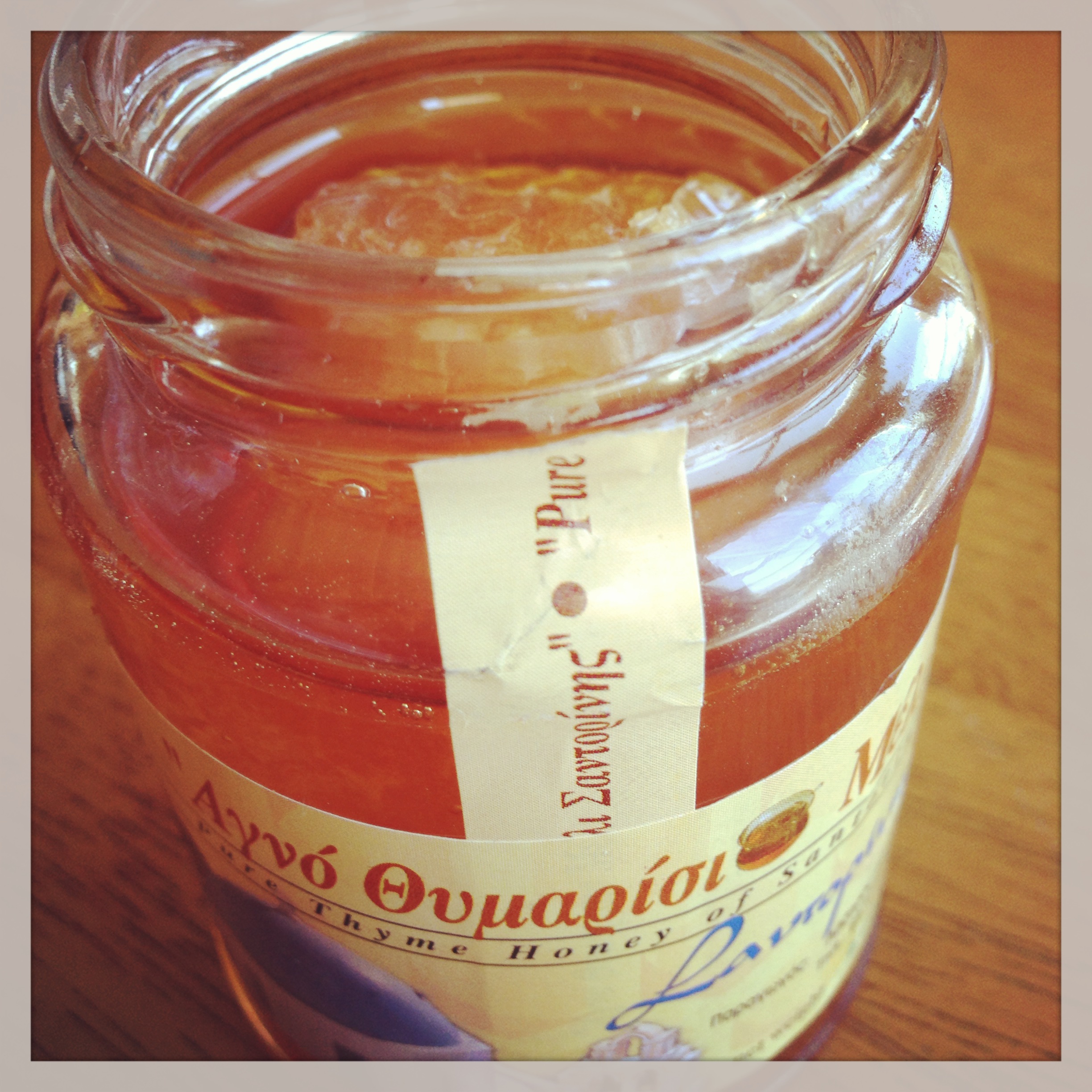
Your letter to me was pure honey.

honey

My students and I laugh, then I challenge them to write, in one sentence, the primary idea they are trying to express.  It seems extreme to suggest they rephrase 150 times, so I suggest they come up with 10 ways to say the same thing.

While they infuse their ideas with new language, I perform a twist on that exercise, using quotes I find on voice which utter similar ideas.

“A powerful and fundamental aspect of who we are: our voice.” – Rupal Patel (TED talk).

 …a voice is like a fingerprint, possessing a constant and unique signature.” – Seamus Heaney (from a 1974 lecture).

“Oh how wonderful is the human voice! It is indeed the organ of the soul!” Flemming, the protagonist in Henry Wadsworth Longfellow’s novel, Hyperion: A Romance.

Now I’ve slightly misled you with that last quote as I didn’t easily find it, although a variation of it appears in Patel’s TED talk, is easily found on Brainy Quote and Goodreads and ThinkExist in a cleaned up, simplified, edited version of the above, stripped of its two exclamation marks, devoid of its sounding like a man falling in love which is exactly what’s happening to Flemming in Hyperion: A Romance, a thinly disguised Longfellow at the time.

Time has been kind and replaced Longfellow’s romantic exuberance with a more mature sound.

“The human voice is the organ of the soul.” – Longfellow

In that revision I hear a restrained baritone utterance with a genteel New England accent.  It took quite a bit of sleuthing to find the original from Hyperion: A Romance.  

It can be difficult to find your voice, I tell my students. But if you don’t, someone will speak for you, or paraphrase you, or give you “Perfect Paul” when you’re really Perfect Cath.

They nod and we begin anew the effort to sound like no one but our selves.

With fingers crossed I’ll be a surrogate,
~Catherine

You can watch Rupal Patel explain her VocaliD project in this video:


“All I have is a voice…”

By Catherine Keefe
Up until 1963, when home movies were silent and telephone answering phones didn’t exist, the only way to know your own voice was to hear the sound you made in your head. And then one day right before Christmas my father brought home a small silver box encased in black leather. It’s a tape recorder! He invited me to sing into a microphone.

I have a little dreidel, I made it out of clay…

I sang with my whole heart and soul.  The family sat around the living room waiting to hear how well the new gadget worked. Rewind. Play. Rustle, rustle. Oh dreidel, dreidel, dreidel… I was certain the new toy was broken because the sound was wincingly loud and distorted and much too big for the living room.  All the laughing it caused made the paneled walls vibrate. What was that?

“Stop!” I stood up and shouted. “Stop it now!” In my head I sounded like a choir girl. In reality I made a reverberation like a cross between a goat bleat and toad croaking with swollen adenoids under a mossy river in spring thaw.

rocks

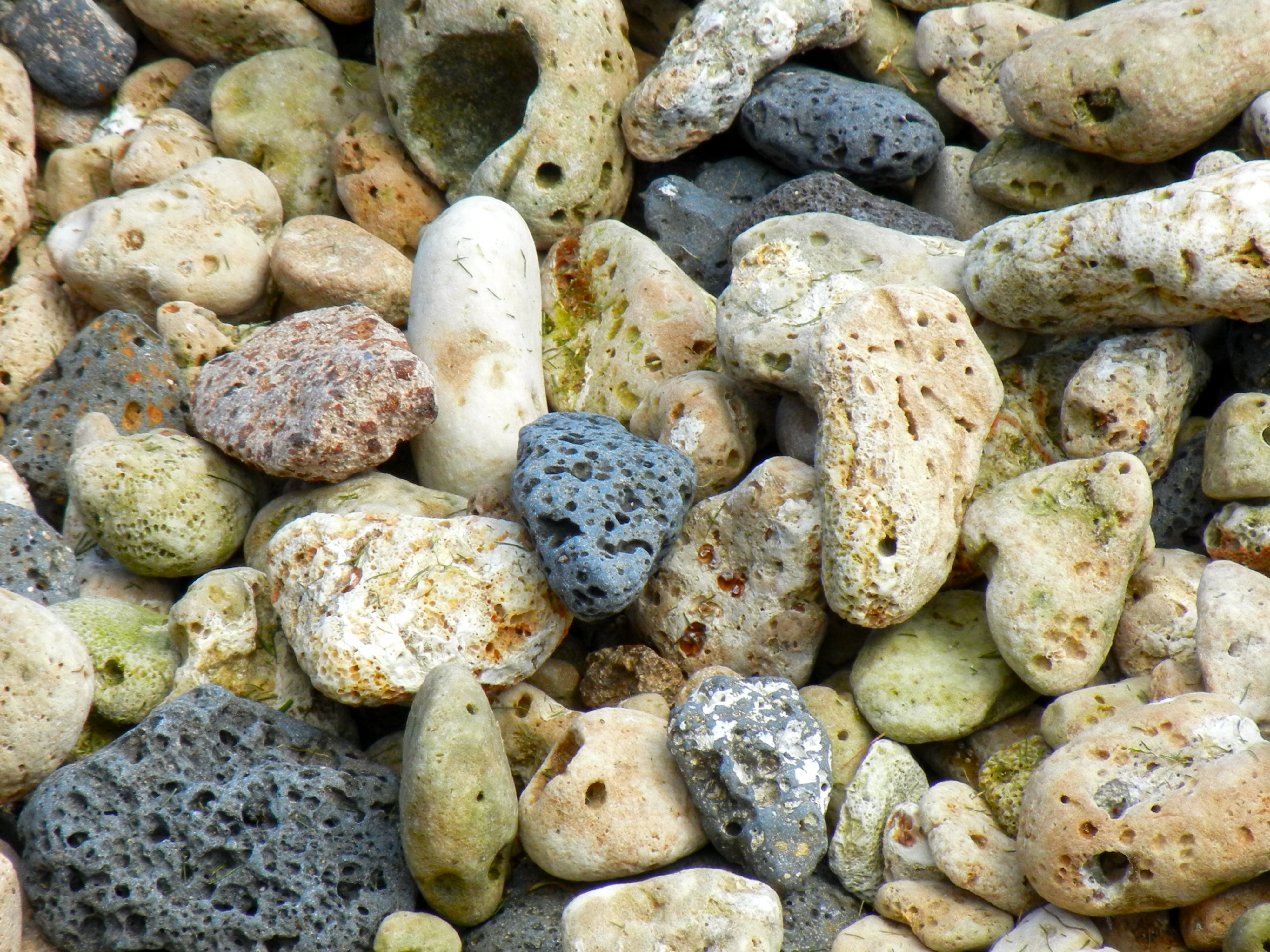
Demosthenes spoke with pebbles in his mouth. I tried that once.

The first time I saw my poetry in print, I hated it too.

i am…

i think.

i’m not really sure.

are you?

It was ten years after the tape recorder incident and my small poem, “i am” was published in the high school literary journal, not a small feat for an underclassman.  I’ve spared you the last stanza.  I’d submitted five poems to the journal and was surprised the editors picked this example of Descartes redux, even though at the time I’d not yet heard of cogito ergo sum.  I thought the poem was too simple then, and when I finally met Descartes’ work in college, I wondered how he got so famous arguing for what I’d already intuited. i am. i think. I dropped the ellipses and began calling my poetry philosophical.

Today I was invited to read my poetry aloud at the upcoming Association of Writers and Writing Programs conference in Seattle at the end of February. I’m thrilled and terrified, though I probably shouldn’t admit to either. The event is a gathering of more than 12,000 writers, editors and book lovers and though I’ve read my writing aloud before audiences of one, of dozens, and hundreds, I’m still unused to my voice in public. I relate completely when poet Sarah Kay says in her TED talk, “My self-confidence can be measured out in teaspoons.”

But there’s something worse than hearing my voice and seeing my words in print. Silence.

“All I have is a voice / to undo the folded lie” wrote W.H. Auden in his poem “September 1, 1939.” It was one poet’s response to the outbreak of World War II.

What’s the distance between silence and sound? There are 30 decibels between pure silence and a library whisper. Decibels are sound units based on what the human ear can hear. The sound of typical conversation reaches 60 decibels.

I imagine that each decibel is one step in an average 10-step staircase. I know I can climb three stories. I whisper. I know I can climb six stories and speak aloud even if it leaves me breathless.

My students, this first week of the new semester, wanted to talk about voice too.  After they asked a variety of questions about assignment word count and final exams and if it was fine to miss class for the Coachella Music Festival, it was my turn to ask a question.

“What do you want from me?”
Silence. That kind where you hear sniffles and shoe scuffs and the lawnmower outside three blocks away.

Then somewhere between a library whisper and full conversation volume, one girl spoke out.  “Can you help me find my voice?”  

Like frogs slowing waking up to sing in the night rain, voices rising upon flights of stairs, a chorus began murmuring, “Yes, that’s what I want too. I want to sound like me.”

“Me too,” I say. “We’re all in this together.”

~Catherine

from “September 1, 1939” by W.H. Auden

All I have is a voice
To undo the folded lie
The romantic lie in the brain
Of the sensual man-in-the-street
And the lie of Authority
Whose buildings grope the sky:
There is no such thing as the State
And no one exists alone;
Hunger allows no choice
To the citizen or the police;
We must love one another or die. –

You can read Auden’s complete poem here: “September 1, 1939.”

Begin again

By Catherine Keefe
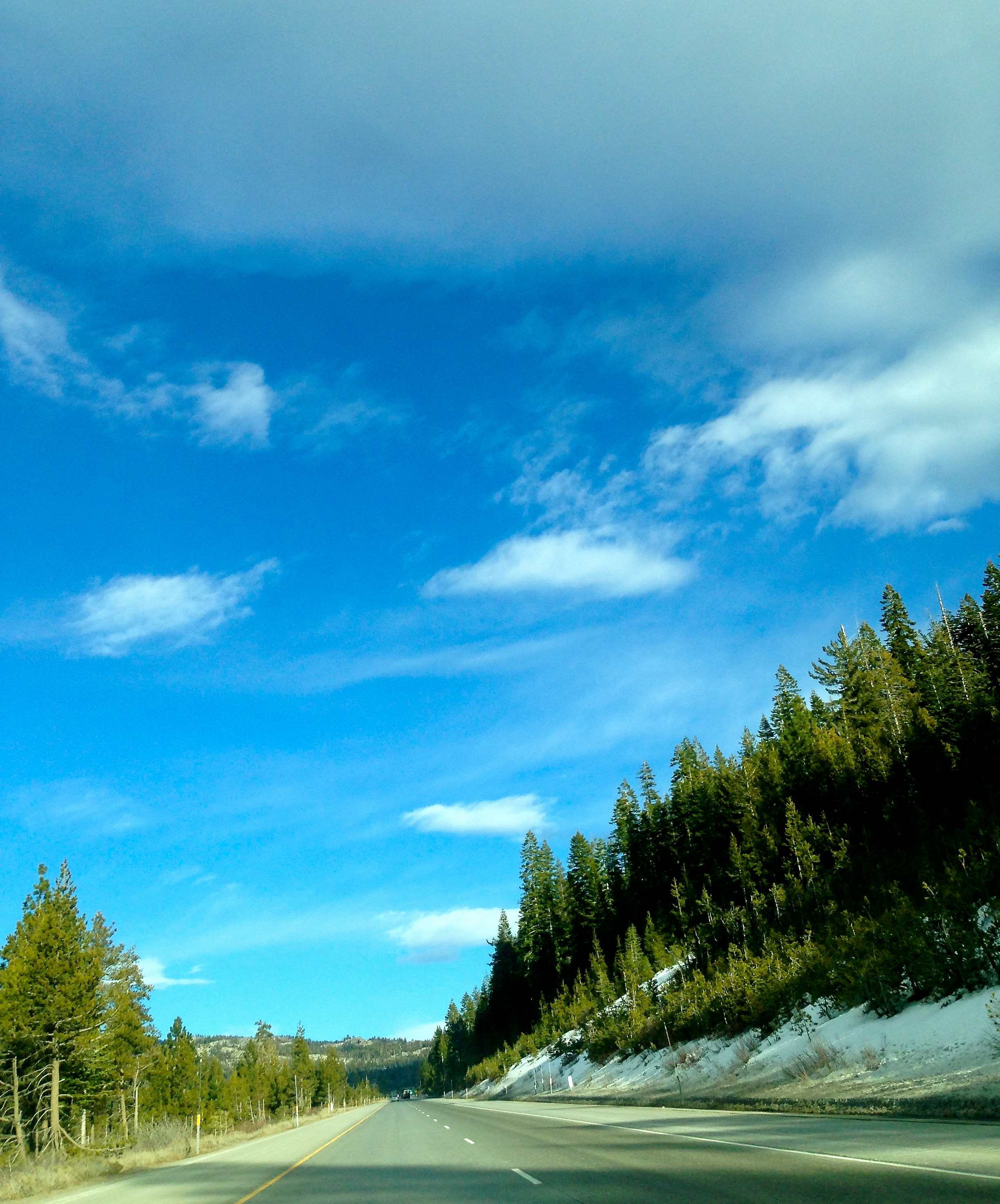
When Weather Underground Lake Tahoe, and the cabin rental agency, and the Squaw Valley ski report, and the friends who live here, and the drought watchers say, “there’s no snow,” I believe them all with the conviction of a woman who packs boots with slippery soles and thin socks for an alpine January vacation with plans of biking and hiking instead of skiing.

I expect no browning snow patches covering the bike path, no puddles melting into ice on the driveway, no leftover frozen white piles hiding the hiking trail.  I imagine dirt and dust and brown pine needle paths still edging the bluest lake in America but no, I definitely don’t imagine snow.

Let me tell you something. There’s no snow like you think there’s no love sometimes, like you want the thrill of skiing the big bowls but the coverage is so light you stay off the mountain so you don’t scratch your new skis and tell everyone there’s no snow, it’s no good. But it is there.

Look – Just now as you come around a corner and catch a glimpse of peaks and those endless pines that aren’t too proud to reach all day, there it is. Snow! Just like love.

photo-69

It might not be new and it surely isn’t making the news, but there’s pure white evidence that you simply forgot how it fell, silent one night at Christmas time which, truth be told wasn’t even a month ago.

There really is snow because it really is winter and even if it’s not showy and causing road closures or lost hikers or skidding trucks or epic skiing conditions it’s there, a little off the beaten path, a drift in the shadows. It shines under the moon and sparkles in the sun.

There’s less than usual, but when hasn’t that been true about something like your perception of the presence of hope or goodness?  So here I am, entirely unprepared clothes wise and shoe wise and activity planning but I couldn’t care less. Why?  Because it’s winter and there’s snow in the mountains and no one acknowledges it is there. Do you see it?

photo-68

Once again, I’m delighted, as a child who first discovers snow and now I’m even more apt to believe what Mark Twain wrote in Roughing It:

Three months of camp life on Lake Tahoe would restore an Egyptian mummy to his pristine vigor, and give him an appetite like an alligator. I do not mean the oldest and driest mummies, of course, but the fresher ones. The air up there in the clouds is very pure and fine, bracing and delicious. And why shouldn’t it be?—it is the same the angels breathe.

In this month of beginnings, under the influence of angels, I once again am allowed the opportunity to let go, especially of expectations.  How blissful to discover I have everything I need after all:
a fireplace.
a match
a husband of 33 years
a contemporary book of poetry written by a woman who lives here
a notebook
a pen

With cold feet,
Catherine

p.s. One of my travel pleasures is picking up a book written by a local author.  If you ever travel to Lake Tahoe, I highly recommend regional poet Judy Tretheway’s book Rubicon Ramblings.

Here’s one of my favorites:

What is Enough?

Tell me how it happens,
magnificent one,
who stretches
into the golden light above the creek. Tell me how you can stand
so full
when under you flows
a rush of water and foam,
rock and debris. The very water that feeds you
washes away
the earth from your roots.
You grab onto the big boulders
while the soil
full of your food travels on. Every other tree I can see
greets the earth with a full embrace.
Your tether is tenuous,
yet it must be enough.What is enough
in this swiftly flowing world?How much security beneath our feet
do we really need
while we reach for our place
in the sun?