A sailor walks into a bar…

Four hundred and ninety three years ago today (ish) Ferdinand Magellan began his expedition to circumnavigate the globe in search of a western spice trade route between Europe and Asia.
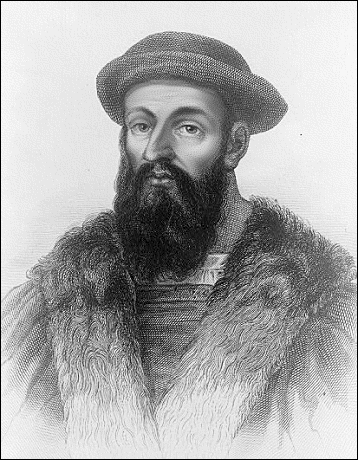
Photo Credit: Public Domain Clip Art

I say “ish” because some sources, like The History Channel, name today as the anniversary but others, notably the Hakluyt Society which publishes “primary records of voyages, travels and other geographical material” offer a different story in The First Voyage Round the Worldfrom a Genoese pilot “who came in the said ship, who wrote all the voyage as it is here.”

According to this sailor’s first-hand account “HE [Magellan] sailed from Seville on the 10th day of August of the said year [1519], and remained at the bar until the 21st day of September, and as soon as he got outside, he steered to the southwest to make the island of Tenerife.”

A sailor walks out of a bar.

I can’t help but think how much writing is like heading into uncharted waters with nothing but a notion.  Sometimes I pursue the end with the diligence of a royal lackey and other times I allow the trade winds of exploration to blow me a bit off course.  When I teach writing, this fluidity between convention and discovery unsettles the students, especially as they try to find their own way, their own voice, to leave their distinct mark in a literary history book.

“Is it good?”
“Should I give up?”
“Do you see any talent in my work?”

I wish students relied less on my coronation and more on the process.

Do you love your journey?
Does your writing reflect your best effort?
Do you trust your boat?
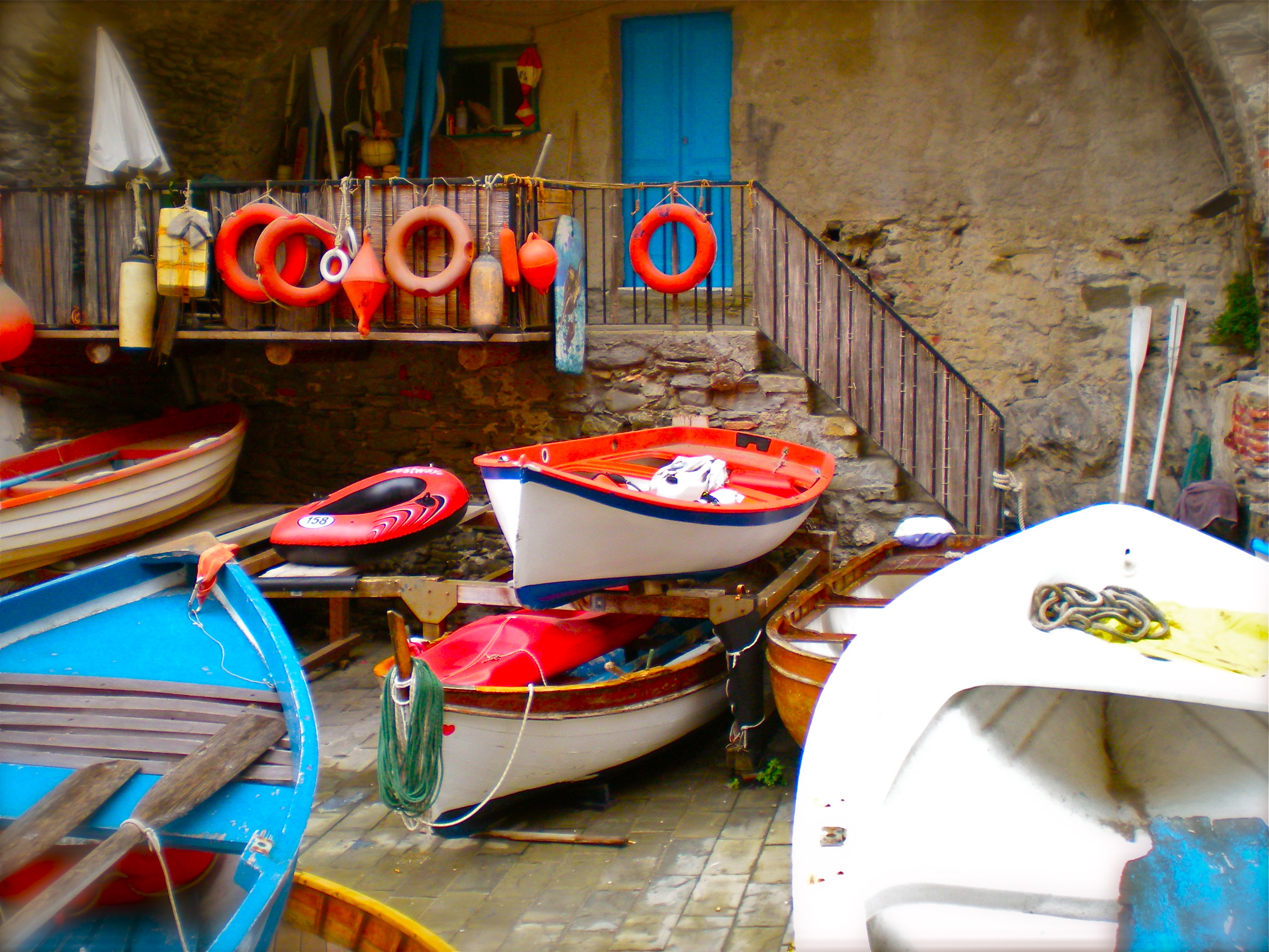
Cinque Terra, Italy. Photo Credit: Catherine Keefe

I wonder if Magellan would have stayed home if he knew he wouldn’t live long enough to receive a hero’s welcome back in Spain. Somehow I doubt it.  If you need fortitude for your literary journey here, to help realign your compass, are two reading recommendations.

If traditional short fiction is your thing, you can’t do any better than getting a subscription to One Story, $21 per year.  From the website:

One Story is a non-profit literary magazine that features one great short story mailed to subscribers every three weeks. Our mission is to save the short story by publishing in a friendly format that allows readers to experience each story as a stand-alone work of art and a simple form of entertainment. One Story is designed to fit into your purse or pocket, and into your life.

If you’re done with tradition and want to experience literature curated to jolt you out of linear, conventional thought, mosey over to Diagram, “a free electronic journal of text and art.  Sure, you can read the fiction and the book reviews there, but the real fun begins when you venture into the schematics link.

from Diagram

From the “Submission Guidelines” page:

WE VALUE the insides of things, vivisection, urgency, risk, elegance, flamboyance, work that moves us, language that does something new, or does something old–well. We like iteration and reiteration. Ruins and ghosts. Mechanical, moving parts, balloons, and frenzy. Buzz us

Here’s wishing you enough squalls to appreciate the peace, enough uncertainty to hone your own beliefs, and plenty of salt spray upon your cheeks.

With delight in discovery,
~Catherine

Friends of the Backyard Sisters

I was a new and nervous reporter, my first minute on the job at the Orange County Register, still trying to figure out office etiquette when working in a long row of cubicles so small and close together and with walls low enough that I could see the stubble on the back of the neck of the reporter in front of me.  Just as I silently sat down, that neck swiveled to reveal a smiling face.

“Hey. I’m Marty.  Welcome. It’s good to have you here.  If you have any questions or need anything, let me know. ”

Long after we left the Register, Marty and I remained writing friends and, huge caveat here, fans of each other’s work.  I invited my writer friend to stop by the backyard to tell you about his new nonfiction book, “The Wild Duck Chase.” It’s about the obscure Federal Duck Stamp Program and the strange and wonderful world of competitive duck painting.  Weird? You betcha. It’s a highly entertaining book that’s a perfect fit for our outdoorsy, michikusacentric focus here at the Backyard Sisters. Best of all, it invites a reader to tackle stereotypes.

Welcome, Marty. It’s good to have you here.

Photo Credit: Jason Wallis

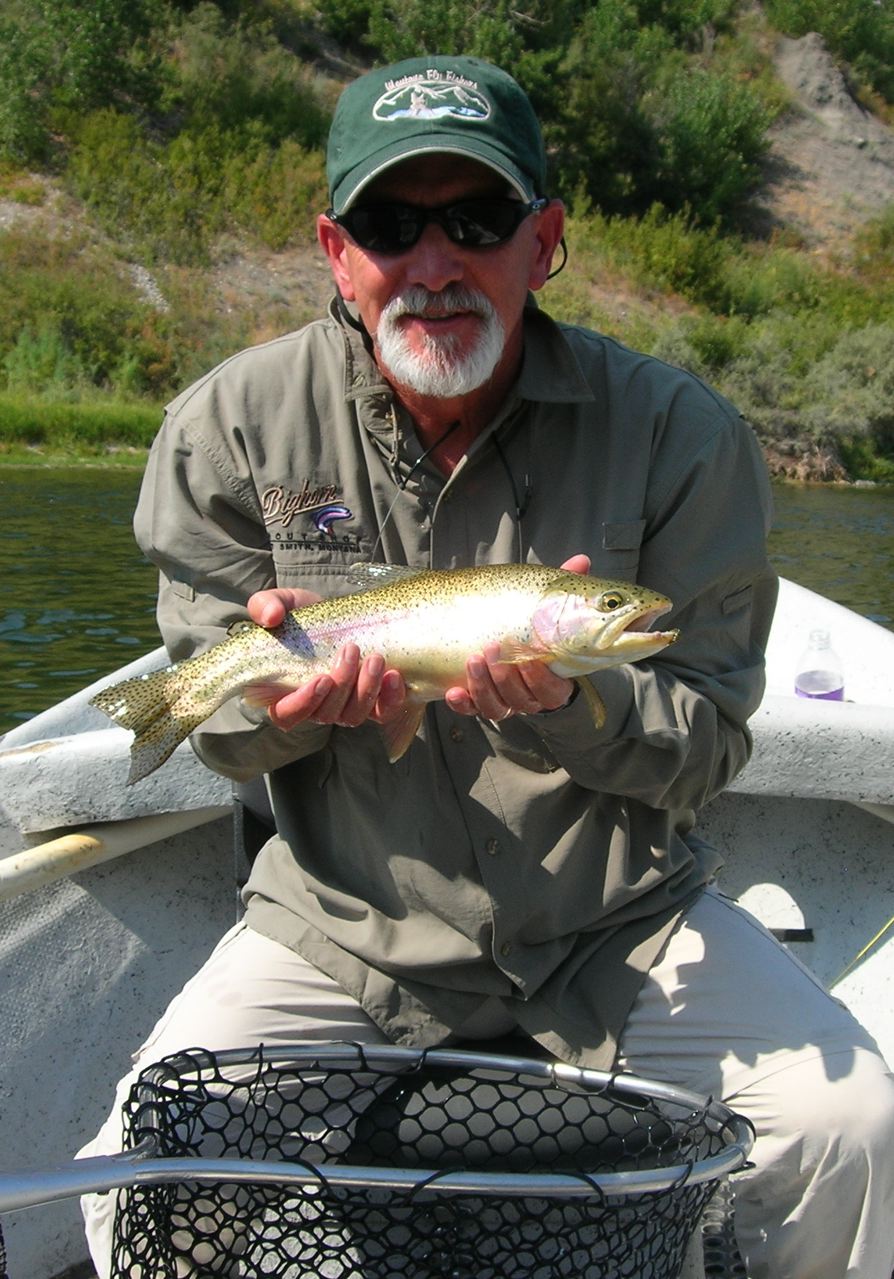
Just back from a fly-fishing trip to the Bighorn River in Montana, and was struck again (as I was while writing “The Wild Duck Chase”) by the depth of knowledge that dedicated outdoorsmen and -women have about the natural world. Robert Bealle, the 2009 Federal Duck Stamp Artist, was able to tell the specific stretch of the Potomac River where the duck he’d shot had been feeding, because of the unusual type of freshwater clams he found in the duck’s craw. One of our fishing guides on the Bighorn put a tube down the throat of a brown trout I’d landed and suctioned out the contents of its stomach to see which type of flies and worms it had been feeding on that morning (so he could choose the proper fly for my next cast). Another guide noticed a nasty wound on another fish I’d landed and deduced that the little fella had a recent brush with a spike-beaked blue heron. Still another spent at least 10 minutes trying to revive a lethargic but still-living brown trout by washing water through its gills. Now, I’m not a hunter, and not much of a fisherman. But after two years of research on the book and my accumulated experiences among hunters and fishermen, I no longer have much patience with those who dismiss them as exploiters of wildlife. They are, for the most part, mindful custodians of a world the rest of us appreciate primarily in theory.

Montana’s Finest

Marty, (that’s Martin J. Smith to you) will discuss his new book and sign copies at the
Big Orange Book Book Festival in Orange, California at 1 p.m. Friday, Sept. 21. If you’re not interested in what many consider the single greatest conservation initiative in human history, or the quirky annual art contest at its center, or a cast of characters that includes a guy who keeps 15 dead birds in his Sears Kenmore freezer, then perhaps you’ll be tempted to attend by knowing that Marty will reveal the name of the artist who managed to paint an entire passage of incredibly filthy porn movie dialogue into his entry, which was then soberly displayed by oblivious federal officials who take this stuff VERY seriously.

Marty will also be reading at Barnes & Noble in Huntington Beach, 9/18 at 7 p.m.; Book Soup in West Hollywood, 9/19 at 7 p.m.; The Book Frog in Rolling Hills Estates, 9/22, time TBA.  If you happen to be in Ogden Utah on 9/28, Marty will speak and sign books in the Weber State library at 3 p.m. right after the first round of judging for this year’s Federal Duck Stamp Contest.

Still not sure?  Read a witty review of The Wild Duck Chase here.

In addition to telling you about a great book, and a kind writing friend, I leave you with one more lasting bit of Backyard Sisters wisdom.  Writers who are supportive of other writers (and editors) sure make the world a kinder gentler place.  Have you given a shout-out to a writer you admire today?

With high regard,
~Catherine

What are you doing in my dream?

Dear One,
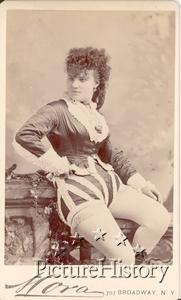
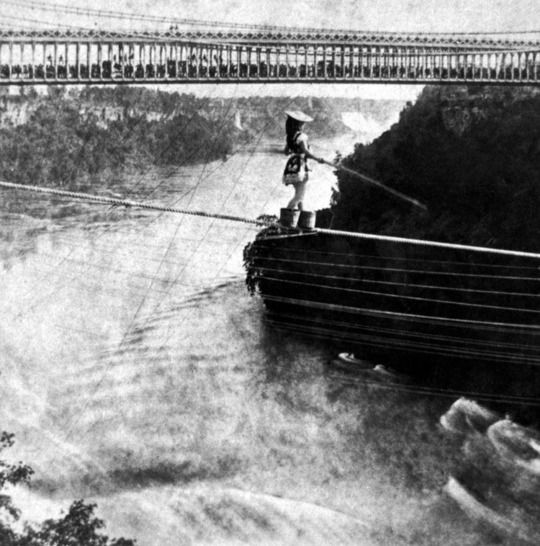
Sometimes, when the writing is precarious, I feel like Maria Spelterini, the only woman to traverse Niagara Falls on a tightrope.

Even though I sit in at my pine desk in a black pleather chair from Staples, I may as well be alone on a high wire, miles above the earth, walking a strand thin as gossamer strung between invisible moons.  From this dizzying height, the din dims. Wind whistles through silver hoops at my ears.

I. Am. Trying. So. Hard. To. Put. Into. Words. This. Thing. This. Thing!

For far too many months I’ve been polishing a poetry manuscript.  It’s good – the process and the work.  But from the great height in the clouds it’s easy to feel lost.

This week I stood firmly on solid ground in front of four university classes filled with new students, faces all turned expectantly toward me.  Some even had pens poised above empty notebooks ready to capture writing secrets.

“Why are you here?” I asked.

I want to be a good writer.
I want to be a better writer.
I’m a terrible writer; I think there’s no hope for me.

I tell them there’s no such thing as a good writer, a better writer, a bad or even a worst writer.  Rather there are people who effectively transmit their ideas and dreams and made-up universes, or even their all-too-real stories, with the kind of language that stops others long enough to read what they have to say.  Some are more effective at this language game than others and no matter the style or voice, writers who ultimately stand apart are the ones who find the truth and write it pure, pure enough that a reader discovers a breath more about this thing called humanity.

As Dinty Moore notes in his new little gem, The Mindful Writer: Noble Truths of the Writing Life:

 What we have is ourselves, and that is all we can really write about.”

Moore’s book is fill with all kinds of sage wisdom, dished out thoughtfully in 1-2 page bit, organized around a writer’s quote.  The segment about being ourselves is under a quote by Barbara Kingsolver:

Don’t try to figure out what other people want to hear from you; figure out what you have to say. It’s the one and only thing you have to offer.

After Maria Spelterini completed her first crossing in July, 1876, within a matter of weeks she repeated the feat with peach baskets strapped to her feet, then once again blindfolded, and yet again with her hands and feet bound in iron cuffs.

Sometimes I think I make the writing process more difficult than it needs to be, especially when I begin to circle too closely toward self-doubt, or some other truth I’d rather ignore.  I’m tempted to throw up peach baskets, a blindfold, shackles, or in the case of my poetry book, obscure references to ancient Greek myths and long forgotten gods.

It isn’t just writers who do this. We all at some time face a startling self-discovery with distractions.  We try to affirm that we’re still good enough, daring enough, special enough.  I suppose it’s easy to receive acclaim if you’ve got a high wire and an audience.  There’s far less fanfare for walking the wire of one true self.

One night, I dream I’m Maria Spelterini.  I pause midway in my crossing, the thunder of Niagara Falls all around. I leap, a scissor kick. For one brief second I hang in flight.

Oh—              the view!

With balance and daring,
~Catherine

p.s. Dinty Moore will be a presenter at League of Utah Writers Roundup, September 14-15, 2012.  Click here for more information.

I waited all winter to tell you

under the ancient oak
an empty picnic table

I wrote those lines late last December after a walk with Chester, the big white dog. I remember well the afternoon we wandered in the gloaming, he with all the bounce and romp of a puppy and I with some elegiac tang induced by another year’s looming end.

fog swirling mist
descends upon the night
chill

the stars are crying.

Why so sad? I wonder now in summer’s glare.

summer afternoon shade
untied my shoes

I wanted to tell you how the table surprised me that afternoon when I turned left on the path instead of right. There were no tables anywhere else in sight, just this one simple wooden stopping place.  I waited through January, February, the bluster of March to give it to you, not from the vantage point of the path which ran past it, but with the solidity of its worn wooden bench beneath me, with the joy of describing the summer solstice meal I ate from atop its uneven surface, with the fervent vow to eat al fresco more this summer than last.

So much depends upon a wooden picnic table in a winter afternoon.  I felt a new comprehension of William Carlos William’s 1923 poem, “The Red Wheelbarrow.”

so much depends
upon

a red wheel
barrow

glazed with rain
water

beside the white
chickens

I wanted to tell you how my table seemed embedded in the grass, as if it had roots like the oak above it, how it was the soft brown of shadow on bark with bright orange streaks where a kind of moss grew upon it as if it were a living thing.

By April I vowed to eat at a different picnic table each week this entire summer. I would dine under the sky! Describe parks and beaches and campgrounds! Find new vantage points!

Then I wondered; would that plan celebrate the novel and restless over the warm familiar? Maybe instead, I should resolve to meet this table and this table alone with my basket all summer.

so much depends
upon

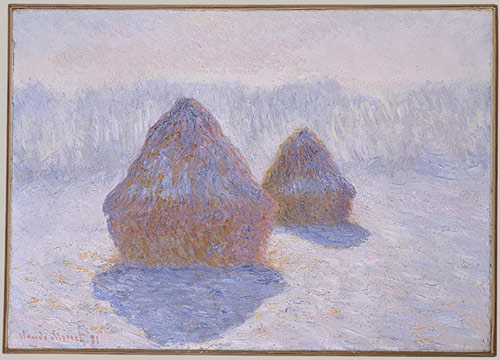
I think of Monet’s Haystacks, the artist’s study of light upon a common object.

I think of Antonio Porchia‘s slim volume, Voices, the writer’s light fixed on common man.

I have scarcely touched the clay and I am made of it.

I think of something as solid as wood in a world which feels more like a river than stone.  Anticipation is delicious.

under the ancient oak
an empty picnic table
summer afternoon shade

Summer begins yesterday.  I wait as long as I can.  Noon turns to afternoon turns to almost twilight. I’m ready with camera and Chester and a brown paper bag full of first peaches because it’s the kind of day where I don’t have time to cook.

We go the long way, take the path which curves first left, then right, then around the bend of the seasonal creek, the path which places the setting sun behind my shoulders which casts my shadow long and makes me look as if I’m always arriving.

Chester pulls on the leash.
And there under the ancient oak.

It’s demolished. The table top now lies at the bottom of the creek bed.

“Certainties are arrived at only on foot,” Antonio Porchia writes in Voices.

Past tense and future crumble the present I was given and never received. As I walk home, I know. I waited too long to whisper my secret wish to picnic with you, but I will tell you now.

~ With high hopes for surprises along your own path, C

Give the people a love story

What are you writing?
Everyone wants to know.
Wretchedly miserable love poems, I say.
The poems or the love?
You, of all people, must know.
(from beach bag journal, 2005)

|<|>|<|>|<|>|

Kauai is a study in couples.

Yesterday’s bride perches poolside, feet dangling in the water.  A fraternity-size of group of men surrounds her, holding out icy cups of beer.

“Drink!”
“Drink!”
“Drink!”

“No more!” she insists and jumps to her feet.

Newlywed

As she sashays away the rhinestone word scripted across her bikini bottom sparkles in the afternoon sun. The man wearing the white Groom hat downs his beer and doesn’t follow.

|<|>|<|>|<|>|

Fewer people will look you in the eye and say, I could be your lover than the number who will say they’re thinking about becoming a writer too.

Which one of these is the harder thing to do?
(from beach bag journal 2006)

|<|>|<|>|<|>|

The friends who join us on this trip point out The Feral Pig, a restaurant that used to be a breakfast place.  “We ate there on our honeymoon. ”

These are the kind of friends we’ve had since before we both married that hot summer of 1980, D and I trading bridesmaid duties.

Today they giggle, then tell us a honeymoon story.

One morning, we saw a couple eating breakfast there.

They just sat at a table, drinking coffee, reading the newspaper.  They never even talked to each other.

We think of that couple all the time.  We don’t to be like them.

|<|>|<|>|<|>|

Repeat after me: Give the people a love story.

Los viejitos sólo deben salir para ser amables.  Old people should only go out in public to be sweet.

This quote is attributed to Leopoldo, the uncle of Aura Estrada, Aura, the muse and amor of author Franciso Goldman, Aura, the woman who died in a freak body surfing accident and then Francisco wrote about her in the most beautiful book I’ve ever read.  In Say Her Name, Francisco says,

“Hold her tight, if you have her; hold her tight, I thought, that’s my advice to the living. Breathe her in, put your nose in her hair, breather her in deeply. Say her name…”

He can write about love like that because he doesn’t have it anymore and no one can accuse him of being sentimental.

I read Say Her Name on the beach and remember a question I once asked an entire class at the end of a semester when I was a literature grad student.

“Where, where is the happy love story, the great literature happy love story?”

Titles peppered me like small darts. Love in the Time of Cholera.  Anna Karenina. Lolita.

So I start with Lolita. I find love in a million masks: obsessiveness, possessiveness, irrationality, kindness, tenderness, anger, illness, forgiveness, relief and release, madness. Is this the only kind of love that makes great books? I really need to know the answer to this. I really need to find a happy love literary feat.

My friend who’s never been to grad school but loves to read suggests Rebecca.   I look it up, it’s a romance novel. I don’t read it.

Maybe love and literature are like the raindrops in a storm.  Who can write well about one small droplet of water without evoking thunder and floods and the loss of sun behind clouds?  One small drop of fresh water. Where’s the miracle in that?

|<|>|<|>|<|>|

“We’re on our honeymoon.”

I tell this to my husband, (isn’t that a glorious word?), I tell my husband this as we stand at Gate 45 in LAX preparing to board our flight to Kauai.

“Our honeymoon. Yes. I like the sound of that.”

In truth, we’ve been married almost 32 years.

|<|>|<|>|<|>|

Writers block only happens when you stop telling the truth.
(Scribbled in my Theory of Fiction Class Notes)

|<|>|<|>|<|>|

The Gray Divorcés

The divorce rate for people 50 and over has doubled in the past two decades. Why baby boomers are breaking up late in life like no generation before.
Wall Street Journal headline, March 2012.

One small drop of fresh water. Where’s the miracle in that?
Repeat after me:
Give the people a love story.

|<|>|<|>|<|>|

You don’t brick over the hearth if the fire burns out.  You gather kindling and tinder. You haul in logs from the woods.  Hell, you cut down the whole damn forest  if you must.

You hold a long-stemmed match to crumpled paper of your past and breathe and blow to fan the flame. You swear to tend this fire as if your life depends upon it.

You don’t want to be that couple that doesn’t hold hands on the beach, nor the one who doesn’t talk at dinner.  You want to be that one over there, the one laughing in the surf, holding hands.  I wonder if they’re on their honeymoon?

|<|>|<|>|<|>|

“Write love stories. I benefit when you write love stories. I’ll be your research.”
J says this to me one day when I say I’m only writing sad stories.
(From my journal, March, 2007)

|<|>|<|>|<|>|

Just don’t lie to me says the writer to the heart. It makes the work turn out badly.

|<|>|<|>|<|>|

I tell J I’m sorry. I can’t write a happy love story. I wonder though: can I write you a life instead?

~With love, C

Dear one who sent me this note:

It’s hard to be confident in my writing when I read the works of geniuses like Andreï Makine or Irene Némirovsky. I read and I wonder if anything I write will ever be as good. But I’m trying to not be discouraged and to keep writing. Thank you again for all of your advice…
L.


To this, I reply:
Oh cher étudiant,

Do these words come from the same woman I once described in a recommendation letter as having an “abundance of intellectual curiosity” with “the ability for sound discernment?”  It’s so simple to recognize talent and bursts of greatness in another; nearly impossible to see ourselves reflected with pleasure.

You do know that “I’ll never be as good” is a refrain from your own Songbook of Fear and Despair.

If you write to surpass your literary ancestors you may succeed. Or, you may not.  But you’ll certainly grow a weed of discontentment because, wild word child, how will you measure that kind of benchmark? Will the yardstick be labeled “sales” or “critical acclaim” or “awards won?”

Is this desire coming from the same woman who once argued in a paper, “They Can Save Their Self-Righteousness for a Better Cause,” that critics might censure literature while not realizing it could be their own unfamiliarity with perspectives from societal margins which creates literary discord, rather than some artistic failing by the writer?

You will write from the heart, with developed technique, because you can’t sleep at night until you have your say. You will write and rewrite and rewrite again because you’re building your personal House of Words and “as good as” be damned because your work is yours alone crafted with all the voice and character that sings from your own sacred self-space.

When you feel faulty, write ten pages, twenty pages, and put them away for one month. When you think you’ve got nothing to say, look at what you once wrote and highlight the passages that still make you smile.  When you feel sorry for yourself, remember the great failures of your literary heroes: Némirovsky was accused of anti-Semitism in her work, and Makine “was growing desperate” to be published before his first work was accepted.

We’ll keep this correspondence just between us because someday, when you know in your heart that you are a writer, you’ll be startled by your insecurity.  I look forward to reading more of your work, even that which you can’t quite stand yet.

Speaking of reading, Makine’s new novel, The Life of an Unknown Man arrives in June.  Do you want to read it together?

Kindly,
A Woman of Letters